
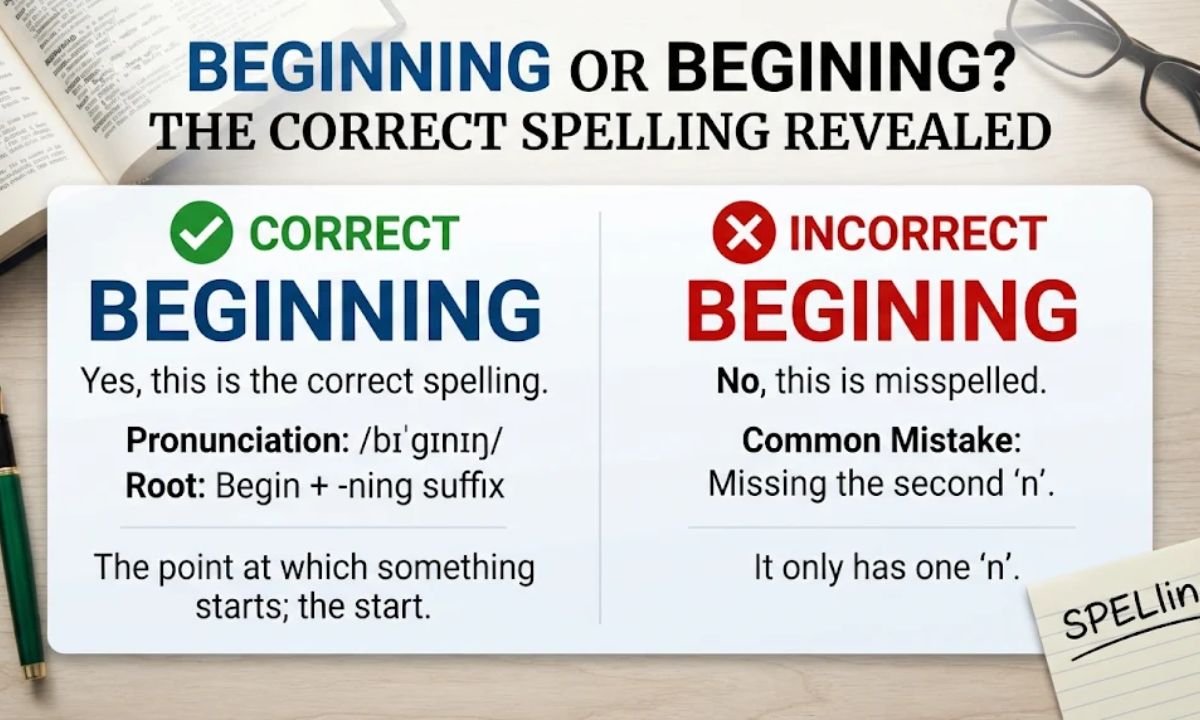
You’re typing quickly, you reach the middle of a familiar word, and suddenly it looks wrong. Is it beginning or begining? The doubled “n” feels unnecessary, so many writers drop one. A simple spelling rule explains why it stays. Beginning is the correct spelling, and begining is a common misspelling. This guide shows you the rule and gives you examples to use right away.
Which Spelling Is Correct: Beginning or Begining?
The correct spelling is “beginning,” with two n’s. “Begining” with one n is always a misspelling. No dictionary lists it as an accepted variant, and it has no legitimate use in American or British English.
The word is spelled the same way in the US, the UK, Canada, and Australia. You won’t find a regional exception to memorize.
What Does Beginning Mean?
Beginning means the point where something starts, or the first part of something. It can describe time, place, or an event.
- The beginning of the semester is always busy.
- She read the book from beginning to end.
- The meeting got off to a rough beginning.
Beginning also works as an action word. When you say “I am beginning to understand,” you mean the understanding is just starting.
Why Does Beginning Have Two N’s?
The double “n” comes from a consistent spelling rule, not a quirk. The verb is begin, and when you add -ing, the spelling changes.
Here is the rule in plain terms. If a verb ends in one vowel followed by one consonant, and the stress falls on the last syllable, you double the final consonant before adding -ing or -ed.
Look at how “begin” fits. It has two syllables: be-GIN. The stress is on the second syllable, and it ends in a vowel (i) plus a consonant (n). So the n doubles, and you get beginning.
Other verbs follow the same pattern:
- Occur becomes occurring.
- Forget becomes forgetting.
- Prefer becomes preferring.
- Admit becomes admitting.
Words with the stress on the first syllable usually don’t double. That’s why visit becomes visiting, open becomes opening, and listen becomes listening.
The same rule gives us beginner, which also has two n’s. If you remember “beginner,” you can remember “beginning.”
Is Beginning a Noun, Verb, or Adjective?
Beginning is flexible. It plays several roles depending on the sentence.
As a noun, it names the start of something:
- At the beginning of the lesson, we reviewed last week’s homework.
As a present participle (a verb form ending in -ing), it shows an action in progress:
- The team is beginning a new project.
As a gerund (a verb acting as a noun), it can be the subject of a sentence:
- Beginning a business takes patience.
As an adjective, it describes another noun:
- The school offers a beginning Spanish course.
The base verb is irregular. Its forms are begin (present), began (past), and begun (past participle). For example: “We began at noon,” and “We have begun the review.”
The plural noun is beginnings, as in “Every great company has humble beginnings.”
Beginning vs. Begining at a Glance
| Term | Correct? | Meaning | Use |
| Beginning | Yes | The start of something, or the act of starting | Use it in all writing, formal or casual |
| Begining | No | None (a misspelling) | Never use it; replace it with “beginning” |
The table makes the choice simple. There is only one real word here, and the other form is a typo that spell checkers will flag.
Read More: Its Called vs It Called: Meaning, Difference & Examples
How Do You Pronounce Beginning?
Beginning is pronounced bih-GIN-ing. The stress falls on the second syllable, which is the same stress as in “begin.”
Notice that you can hear the double n in careful speech. The second syllable ends with the n sound, and the third syllable begins with another one. Saying it slowly (bih-GIN-ning) can help you remember the extra letter when you write.
Where Does the Word Beginning Come From?
The word traces back to Old English. The verb beginnan meant “to begin” or “to attempt,” and it developed into the modern verb begin. Adding the -ing ending created the noun and participle forms we use today.
Over the centuries, spelling in English became more standardized, and the doubled consonant became the accepted form when -ing is added to stressed final syllables. That is the same pattern you see in many other common verbs.
The phrase “in the beginning” is also familiar from the opening of the Book of Genesis in the Bible. It is one reason the word feels so established in English, though the spelling rule itself comes from general English patterns and not from any one text.
How Do You Use Beginning in a Sentence?
Here are realistic examples for different situations.
Everyday conversation
- I’m beginning to think we should have left earlier.
- Starting a new hobby is hard at the beginning, but it gets easier.
Workplace communication
- We are beginning the onboarding process next Monday.
- At the beginning of each quarter, the team reviews its goals.
- Beginning next week, our office hours will change to 9 a.m. to 5 p.m.
- I have attached the schedule. Please review the items at the beginning of the document.
Academic writing
- The essay should state its main argument at the beginning.
- Beginning students often struggle with citation formats.
Formal or business writing
- The agreement takes effect at the beginning of the fiscal year.
- The beginning stages of development focus on research and planning.
Why the second academic example works: “beginning” is an adjective describing “students,” meaning students who are new to the subject.
Common phrases that use the word include:
- In the beginning (at the very start)
- From beginning to end (the whole thing)
- At the beginning of (when something starts)
- The beginning of the end (the first sign that something is finishing)
- Beginner’s luck (early success from a new learner)
What Are the Most Common Beginning Mistakes?
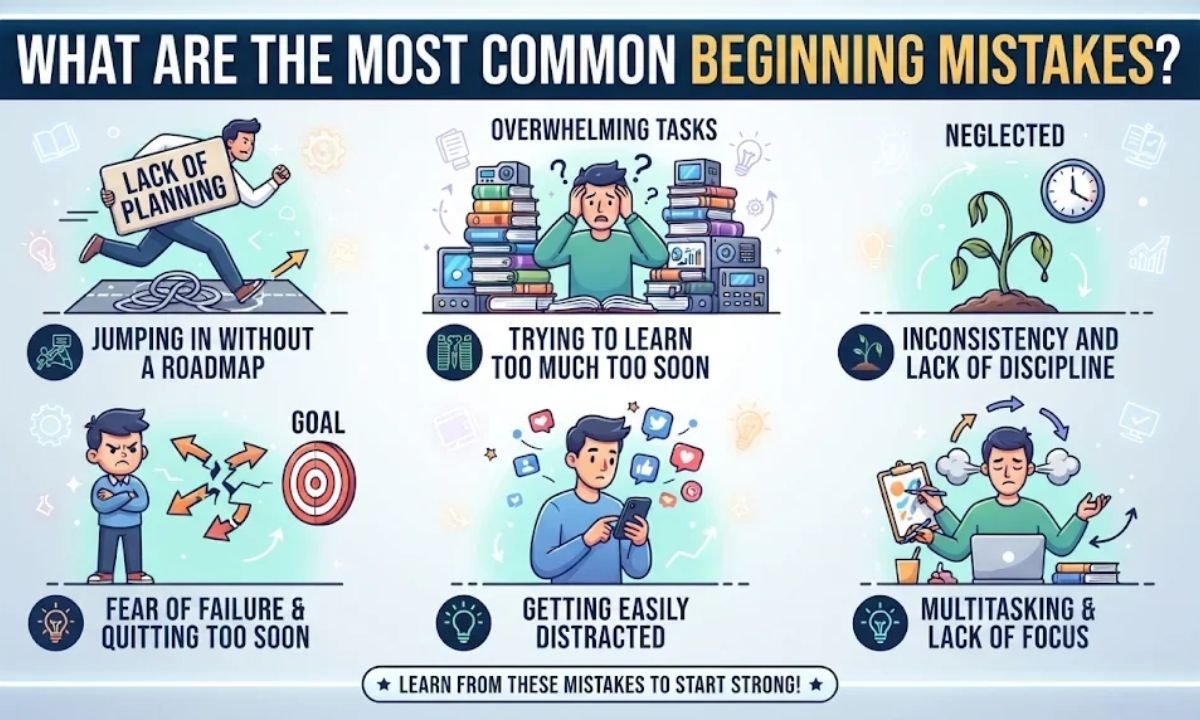
Misspelling this word is very normal, and the reasons make sense. Here are the mistakes that come up most.
Mistake 1: Dropping one n
- Incorrect: The begining of the movie was slow.
- Correct: The beginning of the movie was slow.
This is the classic error. The verb “begin” has one n at the end, so the one-n version feels logical, but the doubling rule applies.
Mistake 2: Adding too many letters
- Incorrect: She is beginning to feel better.
- Correct: She is beginning to feel better.
If you ever type “beginnning” with three n’s, a spell checker will catch it. The right spelling has exactly two n’s in the middle.
Mistake 3: Mixing up the verb forms
- Incorrect: We have began the project.
- Correct: We have begun the project.
“Began” is the simple past, and “begun” needs a helping verb like have or had. This isn’t a spelling error, but it often appears alongside beginning mistakes.
Mistake 4: Writing begginning or beggining
- Incorrect: The beggining of the story is great.
- Correct: The beginning of the story is great.
Some writers double the wrong letter. Only the n doubles. The g stays single.
Which Words Are Related to Beginning?
Knowing related words helps you vary your writing and avoid repeating yourself.
Synonyms for the noun:
- Start
- Opening
- Outset
- Onset
- Origin
- Launch
- Commencement (more formal)
Antonyms:
- End
- Finish
- Conclusion
- Close
Related forms:
- Begin (verb)
- Beginner (a person who is new to something)
- Beginnings (plural noun)
- Beginning (adjective, as in “beginning level”)
Similar words that follow the same doubling rule:
- Running
- Stopping
- Planning
- Getting
- Referring
Be careful with synonyms. “Commencement” sounds formal and often refers to a graduation ceremony in American English, so “beginning” or “start” is usually the better everyday choice.
How Can You Remember the Correct Spelling?
A few quick tricks make the spelling stick.
- Think of “beginner.” You would never write “begíner,” so the double n in beginning should feel natural.
- Say it in three beats. Say “be, gin, ning” out loud, and you’ll hear the n repeat.
- Use the stress test. If the last syllable of a verb is stressed and ends in vowel plus consonant, double the consonant before -ing.
- Picture the middle. The word has a small double “nn” in the center, like two steps in a staircase.
If a doubt ever creeps in, type the word and let your spell checker confirm it. Then try to use the correct spelling once or twice that day, because repetition builds memory faster than any rule.
FAQ’s
Is “begining” ever correct?
No. Begining is not a word in standard English. It is a common typo and should be replaced with “beginning” in every case.
Why does beginning have two n’s?
Because the verb “begin” ends in a single vowel and consonant, and its stress is on the last syllable. English doubles the final consonant before -ing, which gives beginning.
Is beginning spelled differently in British English?
No. American and British English both use beginning. The spelling is identical in both varieties.
How do I use beginning in a sentence?
Use it to name the start of something or to show that an action is starting. For example: “At the beginning of the year, I set three goals,” or “I’m beginning to enjoy this book.”
What is the past tense of begin?
The simple past is began, and the past participle is begun. For example: “She began early,” and “She has begun her research.”
Conclusion
The correct spelling is beginning, with two n’s, and the form with one n is only a typo. The extra letter comes from a reliable rule: double the final consonant when a stressed last syllable takes -ing. If you can spell “beginner,” you can spell “beginning.” Keep that one connection in mind, and the word will stop tripping you up.

Alex Jhon is the admin of Swift Timely, passionate about English grammar, word comparisons, vocabulary, and helping readers improve their language skills with clear, simple explanations.