


Ever stopped mid-sentence wondering whether a bird flys or flies? The word seems like it should just take an s, but English changes the ending. “Flies” is the correct spelling. “Flys” is not a standard word in modern American English. Below, you will see why the spelling changes, when to use each form, and how to avoid the mistake.
Which Is Correct, Flys or Flies?
Use “flies.” It is the correct third-person singular form of the verb “fly” and the correct plural of the noun “fly.”
“Flys” does not work as either one in standard US English. If you type it in a formal document, spell checkers will flag it, and editors will fix it.
Here is the quick version:
- She flies to Denver every Monday. (verb)
- Two flies landed on the sandwich. (noun)
Flys vs Flies at a Glance
This table sums up the difference.
| Term | Correct? | Meaning | Use |
| Flies | Yes | Verb: travels through the air. Noun: more than one fly (insects, fishing lures, baseball hits) | Use for “he/she/it flies” and for plural “flies” |
| Flys | No (in standard US English) | No standard meaning | Avoid in everyday, academic, and business writing |
| Fly | Yes | Verb base form, singular noun, or adjective | Use for “I fly,” “a fly,” and “a fly design” |
Why Does “Fly” Become “Flies”?
The change comes from a basic English spelling rule. When a word ends in a consonant plus y, you usually change the y to i and add es.
The word “fly” ends in the consonant l followed by y. So it becomes “flies.” The same rule applies to many common words:
- cry becomes cries
- try becomes tries
- reply becomes replies
- city becomes cities
Words that end in a vowel plus y behave differently. You simply add s, as in “play” becomes “plays” and “key” becomes “keys.” That is why “flys” looks plausible but breaks the pattern. The letter before the y is a consonant, so the y has to change.
How Do You Use “Flies” as a Verb?
As a verb, “flies” is the third-person singular present tense form. Use it when the subject is he, she, it, or a single person or thing.
- My brother flies home for the holidays.
- The plane flies at 35,000 feet.
- Time flies when you are busy.
For other subjects, use the base form “fly”: I fly, you fly, we fly, they fly.
The verb has several meanings. It can describe moving through the air, traveling by plane, operating an aircraft, or moving quickly. Each of these meanings uses the same spelling rule.
Read More: Flys vs Flies: Which Spelling Is Correct?
How Do You Use “Flies” as a Noun?
As a noun, “flies” is the plural of “fly.” The most common meaning is the insect, but the word has several other uses.
- Insects: Flies buzzed around the picnic table.
- Fishing: He tied three new flies before sunrise.
- Baseball: The batter hit two sacrifice flies.
- Clothing: Your flies are open. (This usage is more common in British English. Americans usually say “fly” in the singular, as in “check your fly.”)
- Theater: The stagehands worked in the flies above the stage.
In every case, the plural noun is spelled “flies,” not “flys.”
Does “Flys” Ever Count as a Real Word?
In standard modern usage, no. But a few narrow exceptions exist, and they are worth knowing.
Some British dictionaries list “flys” as a plural for an old word meaning a light horse-drawn carriage. You will almost never see it outside historical writing.
You may also see “Flys” as a surname, a brand name, a username, or a stylized spelling in slang. Those are choices made by the person or company, not grammar rules.
For ordinary writing, treat “flys” as a misspelling. If you are writing a school paper, a work email, or a blog post, “flies” is the right choice.
How Do You Pronounce Flies?
“Flies” rhymes with “eyes,” “skies,” and “tries.” In American English, it sounds like /flaɪz/. It is a single syllable.
The final sound is a z, not an s. Say it out loud: “flyz.” That z sound is a useful clue. When you hear it, you know the spelling needs es, not just s.
Pronunciation does not differ between the verb and the noun. “He flies” and “two flies” sound identical, so context tells the listener which one you mean.
Where Does the Word Fly Come From?
The word “fly” traces back to Old English. The verb comes from flēogan, meaning to move through the air. The insect noun comes from flēoge. Both belong to the Germanic language family.
You can see the family resemblance in modern German, where fliegen means “to fly” and Fliege means “fly” (the insect). The two words in English are historically connected, which explains why the same spelling pattern shows up in both the verb and the noun.
Over time, English settled on the “ies” ending for plurals and verb forms of words ending in a consonant plus y. That standard spelling was fixed long before modern dictionaries.
Examples of Flies in Everyday, Work, and Academic Writing
Real sentences help the rule stick. Here are examples from different settings.
Everyday conversation
- My mom flies out of Chicago on Friday.
- There are too many flies in this kitchen.
Workplace email
- Our regional manager flies in tomorrow for the budget review.
- Please confirm when the supplier flies the samples over.
Academic writing
- A house fly typically lives about a month, and fruit flies are widely used in genetics research.
- The migratory bird flies thousands of miles each season.
Notice the last sentence. “Flies” there is a verb because the bird is doing the action. In the sentence before it, “flies” is a noun because it names insects. Ask yourself: is something doing the action, or is something being named? That tells you the part of speech.
Casual writing
- Time flies when you are binge-watching a good show.
Formal writing
- The airline flies to forty cities across North America.
What Are the Most Common Mistakes with Flys and Flies?
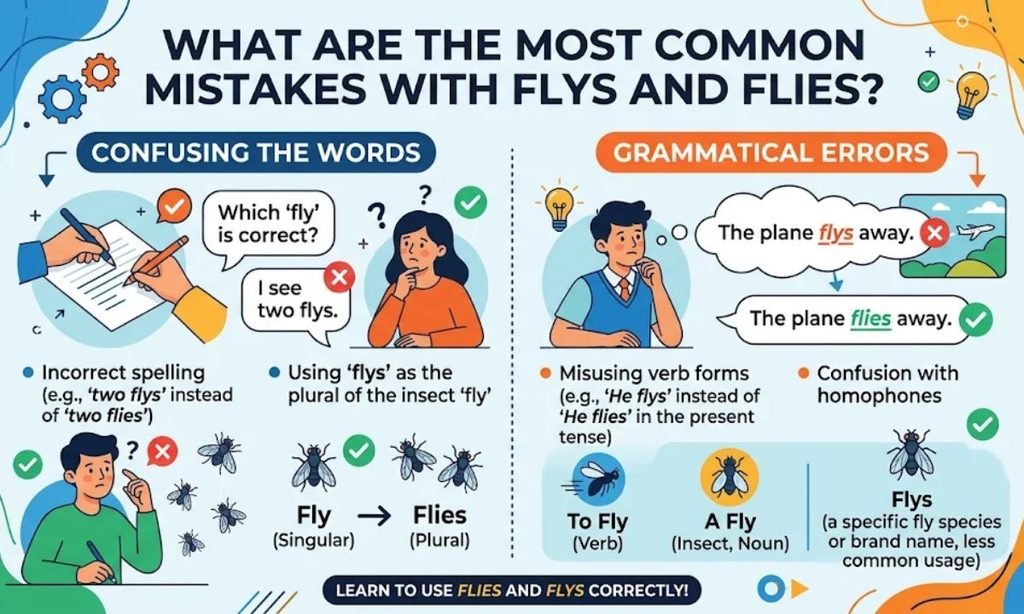
These mistakes are completely normal. English spelling is full of exceptions, and this one catches many writers.
Mistake 1: Adding only an s to the verb
- Incorrect: She flys to Seattle every week.
- Correct: She flies to Seattle every week.
Reason: The verb ends in a consonant plus y, so the y changes to i before es.
Mistake 2: Adding only an s to the plural noun
- Incorrect: There were dozens of flys on the window.
- Correct: There were dozens of flies on the window.
Reason: The same spelling rule applies to nouns that end in a consonant plus y.
Mistake 3: Using “flies” with a plural subject
- Incorrect: The pilots flies the plane together.
- Correct: The pilots fly the plane together.
Reason: “Flies” as a verb needs a singular subject. Plural subjects take “fly.”
Mistake 4: Writing “fly’s” for the plural
- Incorrect: The fly’s were everywhere.
- Correct: The flies were everywhere.
Reason: An apostrophe shows possession, not a plural. Use “fly’s” only for something that belongs to a fly, such as “the fly’s wings.”
What Related Forms Should You Know?
Once you know “flies,” the rest of the verb family is easier. Here are the main forms.
| Form | Example |
| fly | I fly to Boston often. |
| flies | She flies to Boston often. |
| flying | They are flying to Boston tomorrow. |
| flew | He flew to Boston last year. |
| flown | We have flown to Boston many times. |
The verb “fly” is irregular. Its past tense is “flew,” and its past participle is “flown.” Do not write “flied” in general writing.
There is one exception. In baseball, “flied” is the standard past tense for hitting a fly ball that is caught, as in “He flied out to center field.” Outside that sport, use “flew.”
Related terms you might also see include “fly ball,” “fruit fly,” “housefly,” “fly-fishing,” and the adjective “fly,” which in slang can mean stylish.
How Can You Remember the Right Spelling?
Try one of these simple tricks.
- Say it out loud. If the ending sounds like “z,” use “flies.”
- Check the letter before y. If it is a consonant, change y to i and add es.
- Compare it to a word you know. If you can write “cries” or “tries,” you can write “flies.”
- Picture the swarm. Flies are plural, and the word is longer. The extra letters can remind you that one word is not enough.
If you still feel unsure, reread the sentence and ask whether you could replace the word with “cries.” If “cries” fits, “flies” is right.
FAQ’s
Is “flys” a word?
No. “Flys” is not a standard word in modern American English. It appears in rare historical senses, as a surname, or in brand names. For all ordinary uses, write “flies.”
What is the plural of fly?
The plural of “fly” is flies. This applies to insects, fishing lures, and baseball hits. Example: “The fisherman packed six flies.”
Is it “he fly” or “he flies”?
It is “he flies.” The third-person singular present tense takes the “flies” form. Example: “He flies to Atlanta on Tuesday.”
Why isn’t it spelled “flys”?
English changes y to i before adding es when a word ends in a consonant plus y. Since “fly” ends in l plus y, it becomes “flies.”
What is the past tense of fly?
The past tense is flew, and the past participle is flown. Example: “She flew home yesterday.” In baseball, “flied” is used for fly-ball outs.
Conclusion
“Flies” is the correct spelling for both the verb (“she flies”) and the plural noun (“two flies”). “Flys” does not belong in standard writing.
When in doubt, remember the rule: consonant plus y becomes ies. If you can spell “cries,” you can spell “flies.”

Alex Jhon is the admin of Swift Timely, passionate about English grammar, word comparisons, vocabulary, and helping readers improve their language skills with clear, simple explanations.
1 thought on “Flys vs Flies: Which Spelling Is Correct?”