

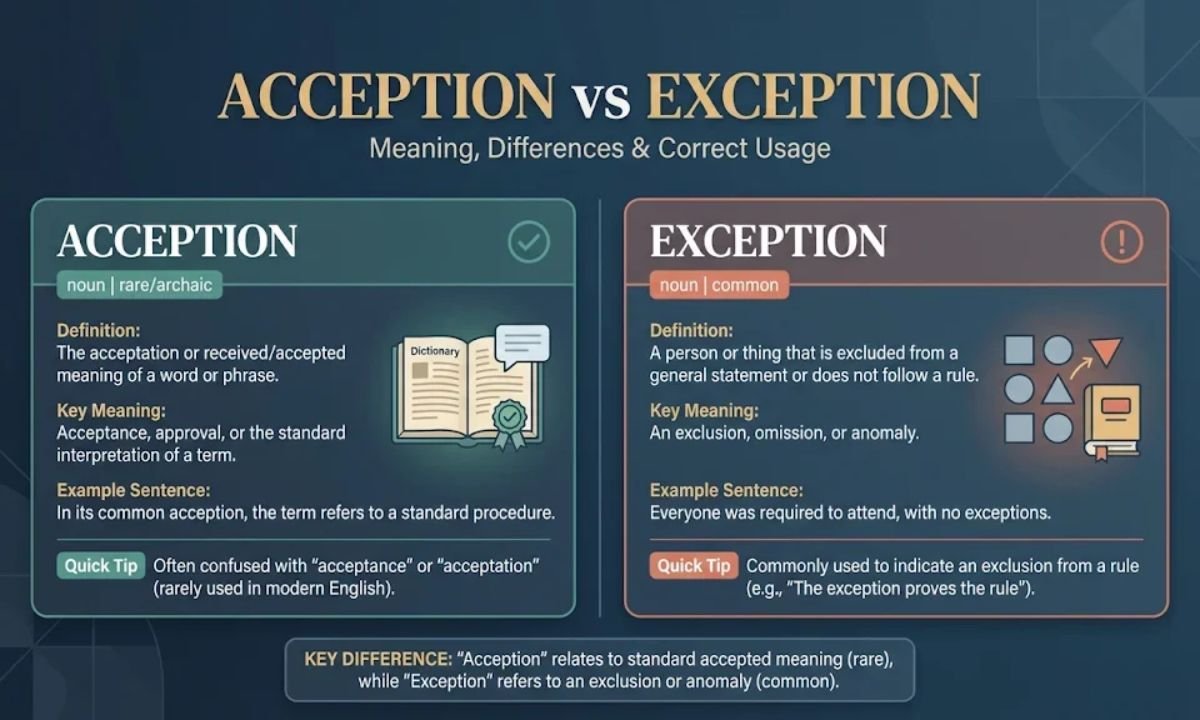
You typed “acception” and wondered whether it is a real word or a typo for “exception.” Fair question. The two look almost identical, and “acception” is easy to confuse with “accept” and “acceptance” too. The short version: “exception” is the word almost everyone needs, and “acception” is a rare, mostly archaic word with a different meaning.
Which Spelling Is Correct, Acception or Exception?
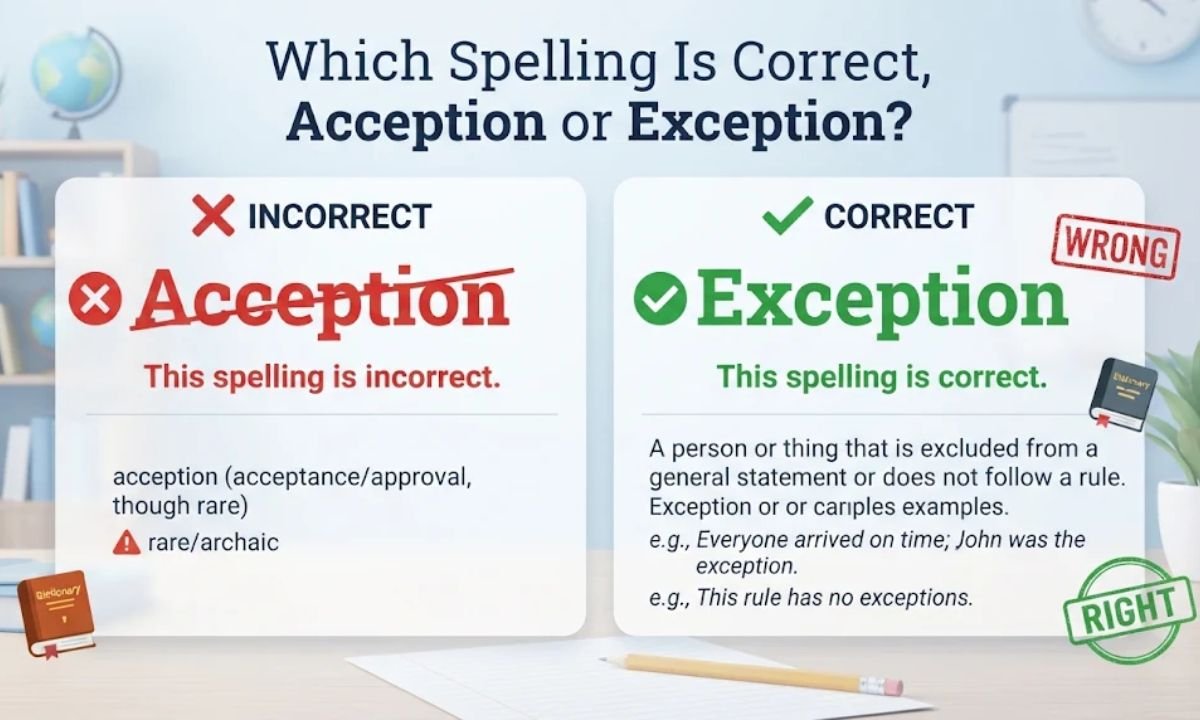
Both are real words, but only “exception” is standard in everyday English. “Exception” means something that is left out or does not follow a rule. “Acception” is a rare noun for the accepted meaning of a word or phrase, and most modern writers never use it.
If you mean “something that doesn’t fit the rule,” write exception. If you are writing about the way a word is generally understood, “meaning” or “sense” is the better choice, and “acception” would sound dated.
What Does Exception Mean?
An exception is a person, thing, or case that is not included in a general statement or does not follow a rule. It marks the place where a pattern breaks.
It also has a few related senses:
- An exclusion: “Everyone passed, with the exception of Daniel.”
- An unusual case: “Snow in July is the exception here.”
- An objection (in the phrase “take exception”): “She took exception to the tone of the email.”
The word is common in everyday talk, workplace writing, legal documents, and even programming, where an “exception” is an error that interrupts normal program flow.
What Does Acception Mean?
Acception is a noun that refers to the accepted or generally understood meaning of a word or expression. Older writers used it when discussing how a term was commonly taken or interpreted.
A sentence using it in the traditional way might read: “In its strict acception, the word covers only written agreements.” Today, nearly all writers would say “in its strict sense” or “by its strict meaning.”
Many dictionaries omit it or label it archaic or rare. A related older form is “acceptation,” which carries the same idea and is usually the more recognizable of the two.
Acception vs Exception: What Is the Difference?
The two words differ in meaning, frequency, and function. Here is a side-by-side view.
| Term | Standard today? | Meaning | Typical use |
| Exception | Yes, very common | Something excluded or not following a rule; an objection | Everyday speech, business, legal, academic writing |
| Acception | No, rare and archaic | The accepted meaning of a word | Older or very formal texts about word meaning |
| Accept | Yes, very common | To receive or agree to something (verb) | “I accept your offer.” |
| Except | Yes, very common | Other than; to leave out (preposition, conjunction, verb) | “Everyone except Maria came.” |
The key point: “exception” is about leaving something out, while “acception” is about how something is understood.
How Do the Grammar and Word Forms Work?
Both words are nouns, and both are countable.
Exception
- Singular: exception. Plural: exceptions.
- Related verb: except (formal, meaning “to leave out”): “Present company excepted.”
- Adjectives: exceptional (unusually good) and exceptionable (open to objection).
- Adverb: exceptionally (to an unusual degree).
- Common patterns: “an exception to the rule,” “with the exception of,” “without exception,” “make an exception,” “take exception to.”
Acception
- Singular: acception. Plural: acceptions.
- It has no common verb, adjective, or adverb forms of its own.
- Related forms: acceptation (the older and more established noun with a similar sense) and the everyday verb accept.
Both spellings are the same in American and British English. Differences between the two dialects don’t change this pair.
Read More: Dought vs. Doubt: Which Spelling Is Correct?
Where Do Acception and Exception Come From?
Both words trace back to Latin, and both share the same root verb.
Exception comes from the Latin exceptio, from excipere, which combines ex- (“out”) with capere (“to take”). So an exception is literally something taken out. The word reached English through Old French.
Acception comes from the Latin acceptio, from accipere, which combines ad- (“to”) with capere (“to take”). That root carries the idea of receiving, which fits the sense of a meaning being “received” or accepted.
The shared capere explains the visual similarity. The prefixes ex- and ad- explain why one word means “taken out” and the other means “taken in.”
How Do You Pronounce Acception and Exception?
Both words stress the second syllable and end with the same “shun” sound.
- Exception: ik-SEP-shun
- Acception: ak-SEP-shun
Only the first syllable differs, and in fast speech it is easy to blur. That is one reason people mix the words up when listening or typing from sound.
How Do You Use Exception in a Sentence?
Here are natural examples across different settings.
Everyday conversation
- “I never eat late, but tonight I’ll make an exception.”
- “Most of my neighbors are friendly, but there’s one exception.”
Workplace and email
- “Please submit all expense reports by Friday. We can’t make exceptions this quarter.”
- “With the exception of the Denver office, all teams have completed the training.”
Academic writing
- “The study found a strong correlation, with one notable exception.”
- “English has many irregular verbs, and ‘be’ is the most extreme exception.”
Formal writing
- “The policy applies to all employees without exception.”
- “I take exception to the claim that the results were conclusive.”
In that last sentence, “take exception” means to object. It does not mean you are carving out a special case. This is the idiom that trips up learners most often.
When Would You Ever Use Acception?
Rarely. You might meet it in older books or in careful writing about language itself. An example:
- “The word ‘nice’ has changed its acception many times since the Middle Ages.”
That sentence is grammatical, but most editors would suggest “meaning” or “sense.” Using “acception” in an email or a school paper will likely read as an error to your audience, even though the word exists.
If you are unsure, choose a plainer word. Your reader will understand “meaning” instantly. Few readers will recognize “acception,” and fewer still will trust it.
What Mistakes Do People Make With Acception and Exception?
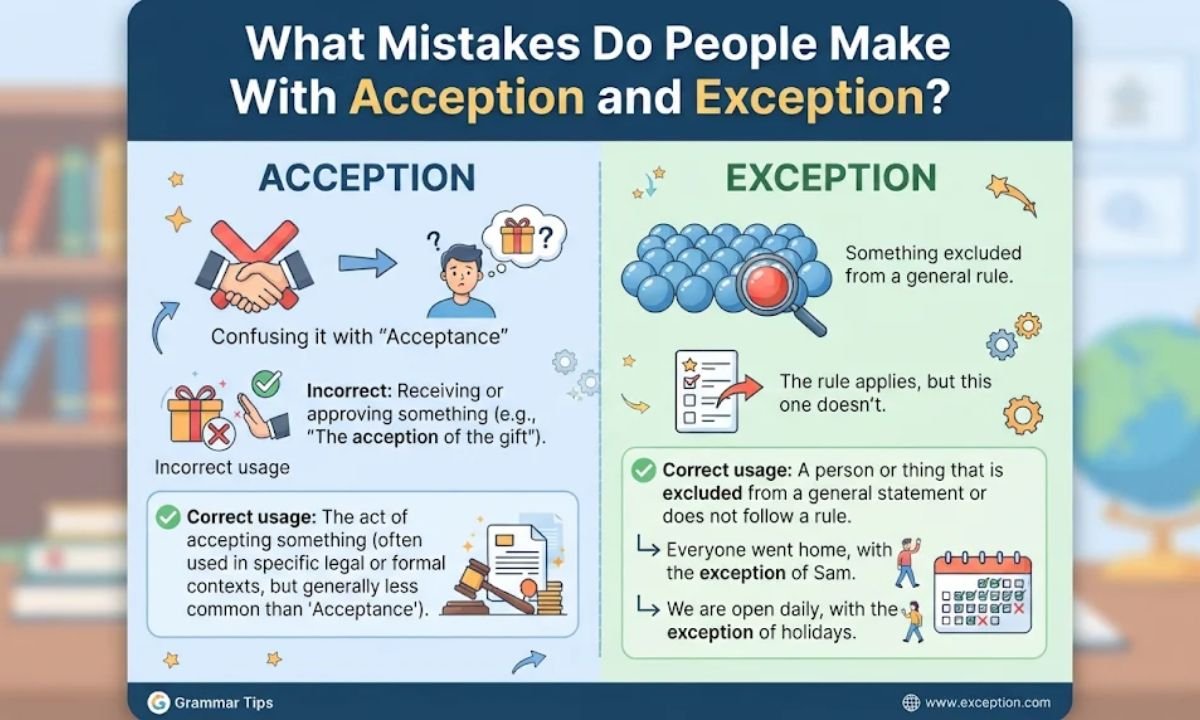
These slips are normal. The words are similar, and spell-check won’t always catch them.
Mistake 1: Using “acception” when you mean “exception”
- Incorrect: Everyone was invited, with one acception.
- Correct: Everyone was invited, with one exception.
The speaker means a case left out, so “exception” is needed.
Mistake 2: Using “exception” when you mean “acceptance”
- Incorrect: Her exception into the program surprised everyone.
- Correct: Her acceptance into the program surprised everyone.
“Acceptance” means being received or approved. It is also the word people usually want when they reach for “acception.”
Mistake 3: Mixing up “accept” and “except”
- Incorrect: I can’t except this gift.
- Correct: I can’t accept this gift.
“Accept” means to receive. “Except” means other than. Think of “accept” as the verb for taking something in.
Mistake 4: Confusing “take exception” with “make an exception”
- Incorrect: I’ll take an exception for you this once.
- Correct: I’ll make an exception for you this once.
“Make an exception” is to allow a special case. “Take exception” is to object.
What Related Words and Phrases Are Worth Knowing?
If you are sorting through this cluster of look-alike words, these are the ones that matter most:
- Acceptance: the act of agreeing to or receiving something. This is the everyday noun related to “accept.”
- Acceptation: an older noun meaning the accepted sense of a word, close to “acception.”
- Accept: a verb meaning to receive or agree to.
- Except: a preposition meaning “other than,” also a formal verb.
- Exceptional: unusually good or an exception to the norm.
- Exceptionable: open to objection. Not the same as “exceptional.”
- Unexceptional: ordinary, not special.
- Rule and exception: the classic pair, as in “the exception that proves the rule.”
- Synonyms for exception: anomaly, outlier, oddity, special case.
- Antonyms for exception: rule, norm, standard.
How Can You Remember the Difference?
A few simple memory tricks help.
- Exception starts with “ex,” like “exit.” An exception is something that has exited the group. Both “ex” words point to being outside.
- Acception starts with “ac,” like “accept” and “access.” It belongs with words about receiving and agreeing.
- When in doubt, ask what you mean. If you mean “left out,” use “exception.” If you mean “approved,” use “acceptance.” If you mean “meaning of a word,” use “meaning.”
Following that last rule will cover nearly every situation you will face.
FAQ’s
Is acception a real word?
Yes, but it is rare and largely archaic. It means the accepted meaning of a word. Most modern writing uses “meaning,” “sense,” or “acceptation” instead.
Is acception a misspelling of exception?
In nearly all modern writing, yes, it behaves like one. If you intend “something that doesn’t follow the rule,” the correct spelling is “exception.” “Acception” has its own separate, older meaning.
What is the difference between exception and acceptance?
An exception is a case that falls outside a rule. Acceptance is the act of receiving or approving something. Example: “The exception was her late arrival, not her acceptance of the offer.”
How do you use exception in a sentence?
Use it when something is left out or breaks a pattern: “All the reports were finished on time, with one exception.” You can also say “make an exception” to allow a special case.
Conclusion
Use exception for anything left out, unusual, or objected to. Treat acception as a rare, old-fashioned word about word meaning that you will almost never need.
If you want one quick rule: when you mean “the thing that doesn’t fit,” write an exception, and when you mean “agreeing to something,” reach for accept or acceptance.

Alex Jhon is the admin of Swift Timely, passionate about English grammar, word comparisons, vocabulary, and helping readers improve their language skills with clear, simple explanations.
1 thought on “Acception vs Exception: Meaning, Differences & Correct Usage”