
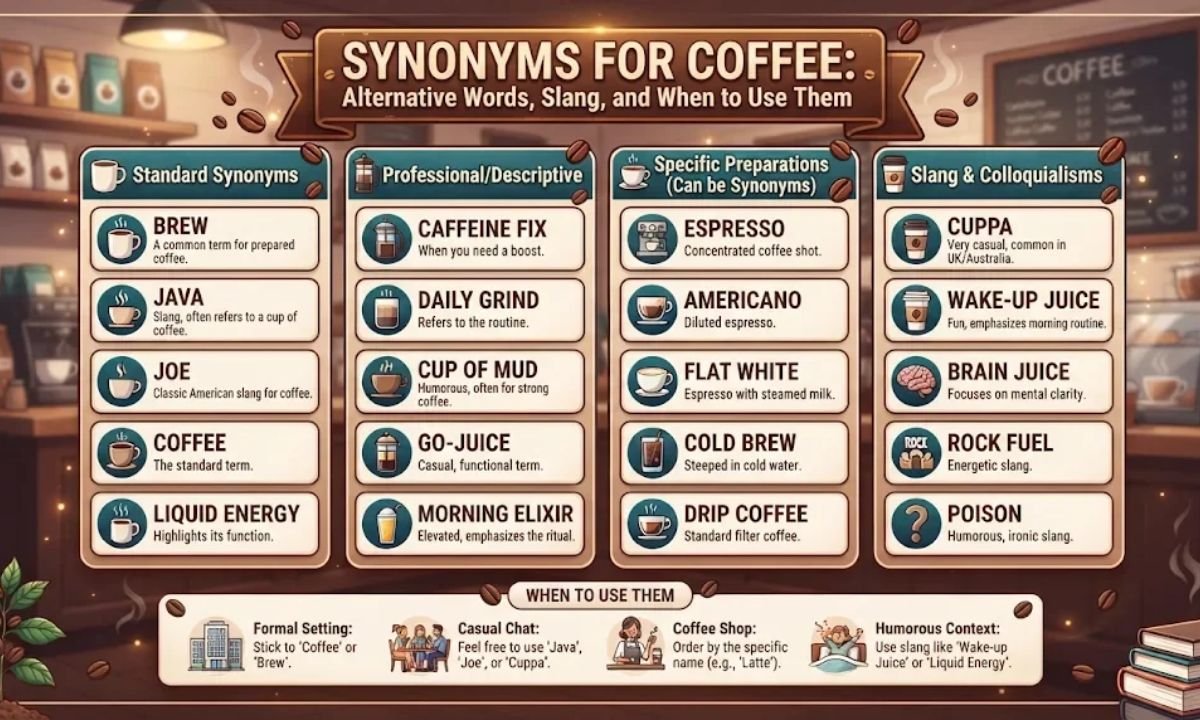
Calling everything “coffee” gets repetitive, but swapping in a fancier word can sound odd if you pick the wrong one. Some alternatives are standard English, while others are slang that only fits casual talk. The best synonyms for coffee are brew, java, and cup of joe, plus informal terms like mud and go juice. This guide explains what each one means and when to use it.
What Is Another Word for Coffee?
The most common alternatives to “coffee” are brew, java, and cup of joe. “Brew” works in most casual and semi-formal settings. “Java” and “cup of joe” are informal and friendly. Slang such as “mud,” “go juice,” and “rocket fuel” suits jokes and casual chat, not professional writing.
That is the short answer. The right choice depends on who you are talking to and whether you mean the drink, the beans, or the idea of a caffeine boost. The sections below sort the options by tone and context.
What Does “Coffee” Mean, and Is It Countable?
Coffee is a noun. It names the drink made from roasted coffee beans, the beans themselves, and the plant that produces them.
As a drink, it is usually uncountable: “I need more coffee.” When you mean servings or types, it becomes countable: “We ordered three coffees,” or “This shop serves several single-origin coffees.”
It can also work as an adjective in front of another noun: coffee shop, coffee table, coffee break. A coffee break, for example, is simply a short pause from work, whether or not anyone drinks coffee.
Common Synonyms for Coffee in Everyday English
These terms are widely understood and safe in most conversations:
- Brew: Refers to the drink, especially freshly made. “Fresh brew” is common in cafés and offices. Note that “brew” can also mean beer, so context matters.
- Java: A casual word for coffee, most familiar in American English.
- Cup of joe: A friendly, slightly old-fashioned phrase for a cup of coffee. It is usually written with a lowercase joe, though you will see “Joe” too.
- Cuppa: A short form of “cup of,” heard mostly in British English and used mainly for tea, though some speakers use it for coffee.
- Caffeine fix: Focuses on the need for caffeine rather than the drink itself.
- Pick-me-up: Any drink or snack that gives you energy. Coffee is the classic example.
Phrases like “a hot cup,” “a mug of coffee,” and “your morning drink” also work when you want to avoid repeating the word without using slang.
What Are the Slang Terms for Coffee?
Slang is playful and informal. It fits texts, social media, and conversation with friends.
- Mud: Strong, dark coffee. The word suggests something thick and bitter, and it is often used with a smile.
- Go juice: Coffee as fuel to get moving. Also appears as “jitter juice” and “wake-up juice.”
- Rocket fuel: Extremely strong coffee.
- Black gold: Coffee as something valuable. Also used for oil, so context matters.
- Liquid motivation: A joking phrase for coffee that gets you through the day.
- Joe and java: Both started as slang and are now so common that most people treat them as ordinary casual words.
Slang changes quickly, so a term that sounds funny to one group may confuse another. When in doubt, choose a plain word.
Where Does the Word “Coffee” Come From?
English borrowed coffee in the early 1600s, and it came through several languages. The word is generally traced to Arabic qahwa, then Ottoman Turkish kahve, then Italian caffè, and finally English.
The name java comes from the island of Java in Indonesia, which became a major coffee-growing region. That is why the word stuck as a nickname for the drink.
The origin of joe is less certain. Several stories circulate, but none is firmly established, so treat any single explanation with caution.
How Do You Pronounce Coffee and Its Alternatives?
In American English, coffee is pronounced KAW-fee or KAH-fee, depending on region. Both are standard.
- Java: JAH-vuh
- Brew: broo
- Joe: joh
- Cuppa: KUP-uh
- Mud: muhd
Stress falls on the first syllable of coffee and java. If you are learning English, say them aloud a few times, because the vowel in coffee is one of the more variable sounds in American speech.
Synonyms for Coffee Compared
| Term | Tone | Meaning | Best Use |
| Brew | Neutral to casual | Freshly made coffee | Cafés, offices, friendly writing |
| Java | Casual | Coffee in general | Conversation, menus, casual blogs |
| Cup of joe | Casual, friendly | One cup of coffee | Speech, headlines, light writing |
| Mud | Slang | Strong, dark coffee | Jokes, informal chat |
| Go juice | Slang | Coffee as energy | Texts, social media |
| Rocket fuel | Slang | Very strong coffee | Humor, casual talk |
| Pick-me-up | Neutral | Any energy boost | Everyday and light professional use |
| Caffeine fix | Casual | A need for caffeine | Everyday talk, informal writing |
Read More: Acception vs Exception: Meaning, Differences & Correct Usage
How Do You Choose the Right Word for Coffee?
Match the word to the setting.
With friends or family: Anything goes. “Want a cup of joe?” and “I need my go juice” are both natural.
At work: Stick to coffee, brew, or pick-me-up. A manager inviting the team to “grab some mud” might get puzzled looks.
In formal or academic writing: Use coffee. Synonyms can distract from your point. If you need variety, use specific terms such as beverage, espresso, or the drink.
In marketing and menus: Brew, java, and cup of joe add personality. A café sign reading “Fresh brew all day” sounds inviting and professional.
Example Sentences Using Coffee Synonyms
Seeing each word in a realistic sentence makes the tone clear.
- Everyday conversation: “I’m heading to the kitchen for a cup of joe. Want one?”
- Casual text: “Rough morning. Need my go juice before the meeting.”
- Workplace email: “There’s fresh brew in the break room if anyone needs a pick-me-up before the presentation.”
- Café menu: “Our house brew is roasted locally and served all day.”
- Blog or magazine: “For many commuters, a stop for java is part of the daily routine.”
- Academic writing: “Researchers studied how coffee consumption affected short-term alertness.”
The academic example keeps the plain word because slang would sound out of place. The email example uses “brew” and “pick-me-up” because both stay friendly without being too playful.
What Mistakes Do People Make With Coffee Synonyms?
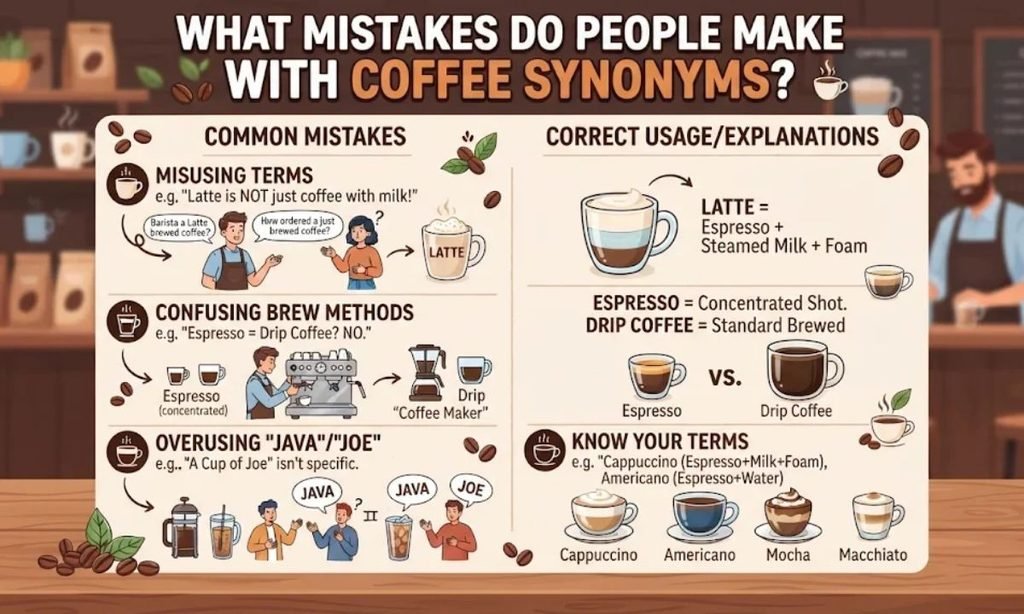
These are normal slips, and each is easy to fix.
Mistake 1: Treating drink names as synonyms.
Incorrect: “A latte is just another word for coffee.”
Correct: “A latte is a coffee drink made with espresso and steamed milk.”
Espresso, latte, cappuccino, and americano are specific drinks, not synonyms. They are types of coffee.
Mistake 2: Using “cuppa” in American settings.
Incorrect: “Let’s grab a cuppa at the café.” (in a US business email)
Correct: “Let’s grab a cup of coffee at the café.”
Cuppa is mainly British and most often means tea.
Mistake 3: Confusing “Java” the island or language with java the slang.
Incorrect: “Our developers need more java to finish the Java project.” (without clear context)
Correct: “Our developers need more coffee to finish the Java project.”
Capital Java can mean the programming language or the island. Using the slang next to it can confuse readers.
Mistake 4: Using slang in formal writing.
Incorrect: “The study measured how mud affected alertness.”
Correct: “The study measured how coffee affected alertness.”
Slang is fine in speech and casual writing, but formal writing needs clear, standard terms.
What Related Words Are Not True Synonyms for Coffee?
Several terms appear alongside coffee but mean something different:
- Espresso: A concentrated coffee made by forcing hot water through finely ground beans under pressure.
- Latte, cappuccino, mocha, americano: Specific coffee drinks, not general replacements for the word.
- Decaf: Short for decaffeinated coffee. It names a type, not a synonym.
- Caffeine: The stimulant in coffee, also found in tea and soda.
- Beans, grounds: The raw material and the used or ground form, not the drink.
- Café: The place that serves coffee, spelled with or without the accent in American English.
Keeping these separate prevents mixed-up sentences like “I’ll have a café” when you mean the drink.
Frequently Asked Questions About Synonyms for Coffee
What is a formal synonym for coffee?
There is no true formal synonym. Coffee is already the standard formal word. For variety in formal writing, use phrases like “the beverage” or name a specific type such as “espresso.”
What does “cup of joe” mean?
“Cup of joe” is a casual phrase for a cup of coffee. Example: “She grabbed a cup of joe before her shift.” The exact origin is uncertain.
Is “java” only slang?
Mostly, yes. As a word for coffee, it is informal. It is also the name of an Indonesian island and a programming language, so capitalization and context tell you which meaning applies.
Can I use “brew” in professional writing?
Yes, in moderation. “Fresh brew” is common in workplaces and cafés. Remember that “brew” can also refer to beer, so make sure the context is clear.
Conclusion
When you want a quick alternative, use brew, java, or cup of joe. Save mud, go juice, and rocket fuel for casual talk and jokes. In formal writing, stay with coffee.
If you are unsure, ask yourself who will read or hear the word. A friend will enjoy the slang, and a professional audience will prefer the plain word.

Alex Jhon is the admin of Swift Timely, passionate about English grammar, word comparisons, vocabulary, and helping readers improve their language skills with clear, simple explanations.
1 thought on “Synonyms for Coffee: Alternative Words, Slang, and When to Use Them”