


You are naming P2O5 and stop short: pentoxide or pentaoxide? The confusion is fair, because the prefix is penta-, so the extra “a” looks logical. Both spellings exist. Pentoxide is the traditional form in textbooks, labs, and safety data sheets. Pentaoxide is the form current IUPAC recommendations prefer for formal systematic names.
Which Spelling Is Correct: Pentoxide or Pentaoxide?
Both are accepted, but they are not equal in everyday use. “Pentoxide” is the standard spelling in most textbooks, classrooms, and commercial chemistry. “Pentaoxide” is the spelling the IUPAC Red Book (2005) recommends, because it keeps the full prefix instead of dropping the final “a.”
So neither one is a typo. If you are writing for a class, a journal, or a company, the right choice depends on which naming convention that audience follows. The sections below explain how to decide.
What Does Pentoxide Mean in Chemistry?
A pentoxide is a compound that contains five oxygen atoms for a given number of atoms of the other element. The word is built from two parts: the prefix penta- (five) and the noun oxide (a compound of oxygen with another element).
Pentaoxide means exactly the same thing. The only difference is whether the final “a” of penta- is kept.
Common examples include:
- Diphosphorus pentoxide (P2O5, often written as the molecular form P4O10)
- Dinitrogen pentoxide (N2O5)
- Vanadium pentoxide (V2O5)
- Tantalum pentoxide (Ta2O5)
- Arsenic pentoxide (As2O5)
Why Do Chemists Drop the A in Penta-?
The short answer is pronunciation. Writing penta + oxide gives you “pentaoxide,” where the “a” and “o” sit side by side. English speakers tend to smooth that sequence out, so the “a” falls away and you get “pentoxide.”
This habit is called elision, which means dropping a vowel to make a word easier to say. It is the same reason we say “carbon monoxide” instead of “carbon monooxide.”
The pattern became a classroom rule: if a prefix ends in “a” and the element name starts with a vowel, drop the “a.” Many general chemistry courses teach it this way. That is why V2O5 is often taught as divanadium pentoxide rather than divanadium pentaoxide.
What Do the IUPAC Rules Actually Say?
This is where the two spellings separate. IUPAC, the international body that sets chemical naming standards, published its inorganic recommendations (the “Red Book”) in 2005. Those recommendations say that the final vowels of multiplicative prefixes should not be elided. The single exception is monoxide, which is allowed because everyone already uses it.
Under that guidance, the formal systematic names are:
- Diphosphorus pentaoxide
- Dinitrogen pentaoxide
- Dinitrogen tetraoxide
IUPAC’s own short guide to inorganic nomenclature uses “pentaoxide” as its example of a name with no elision. In other words, if you are following current IUPAC rules to the letter, you keep the “a.”
Older rule sets and many teaching materials still show the dropped-vowel forms. This is why you will see both in print, sometimes in the same library.
Pentoxide vs Pentaoxide: Quick Comparison Table
| Term | Accepted? | Meaning | Best Use |
| Pentoxide | Yes, very common | Compound with five oxygen atoms | Textbooks, lab reports, supplier catalogs, safety data sheets, everyday chemistry |
| Pentaoxide | Yes, less common | Same meaning | Formal systematic names that follow the 2005 IUPAC Red Book |
| Pentoxid / pentaoxid | No | Misspelling of oxide | Avoid |
| Penta oxide (two words) | No | Incorrect spacing | Avoid |
The key takeaway from the table: the two main spellings differ only in style and convention, not in chemistry.
Read Related Post: Success vs Sucess: Which Spelling Is Correct?
How Do You Say and Write Pentoxide? Pronunciation, Plural, and Grammar
Both words are common nouns, so they are lowercase unless they start a sentence. They are not capitalized when they follow an element name, as in “vanadium pentoxide.”
Pronunciation (US English):
- Pentoxide: pen-TOK-side
- Pentaoxide: pen-tuh-OK-side
The stress falls on the “ox” syllable in both words. The final “-ide” rhymes with “side.”
Plural forms: pentoxides and pentaoxides. Example: “Several metal pentoxides are used in electronics.”
Adjective use: Chemistry writing usually does not turn these words into adjectives. You will see them as part of compound names, such as “a vanadium pentoxide catalyst,” where the whole name works as a noun modifier.
American vs. British English: The spelling of pentoxide does not change between the two. The one nearby difference is the element sulfur (US) versus sulphur (older UK usage), which has nothing to do with the prefix rule.
Where Do Pentoxide and Oxide Come From?
Penta- comes from the Greek word pente, meaning “five.” It shows up across English science vocabulary, from pentagon to pentane.
Oxide entered chemistry through French in the late 1700s. It combines ox-, drawn from the word for oxygen, with the ending -ide, which chemists use for binary compounds. The word oxygen itself traces back to Greek roots meaning “acid” or “sharp” and “to produce,” because early chemists believed oxygen was the source of acidity.
So “pentoxide” is a modern chemistry word that joins a Greek number prefix to a French-origin chemical term. The vowel-dropping habit is a later convenience, not an ancient rule.
Which Spelling Should You Use in Academic Writing?
Use this decision guide:
- Follow your instructor or style guide first. If a course, journal, or company manual specifies a convention, use it.
- If no rule is given, use pentoxide. It is the form most readers expect and the one most reference sources and suppliers use.
- If you are writing formal IUPAC names, use pentaoxide. This applies to papers or databases that apply the 2005 recommendations strictly.
- Stay consistent. Do not write “phosphorus pentoxide” in one paragraph and “nitrogen pentaoxide” in the next.
A helpful side note: the Stock-style name avoids the question entirely. V2O5 can be called vanadium(V) oxide, which uses no prefix at all.
Examples of Pentoxide in Real Sentences
Lab report: “We stored the sample in a desiccator with phosphorus pentoxide to keep it dry.”
Phosphorus pentoxide absorbs water very strongly, which is why it appears in drying setups.
Classroom: “What is the formula for dinitrogen pentoxide?”
The answer is N2O5. The prefix di- tells you there are two nitrogen atoms, and penta- tells you there are five oxygen atoms.
Workplace email: “The supplier updated the safety data sheet for vanadium pentoxide, so please review the handling section.”
Formal IUPAC writing: “The compound was identified as diphosphorus pentaoxide.”
This sentence is correct in a document that follows the 2005 Red Book.
Casual: “My chem professor says pentoxide, but the textbook says pentaoxide. Which one is right?”
Both are right, and the professor and textbook are probably following different conventions.
Common Mistakes With Pentoxide and Pentaoxide
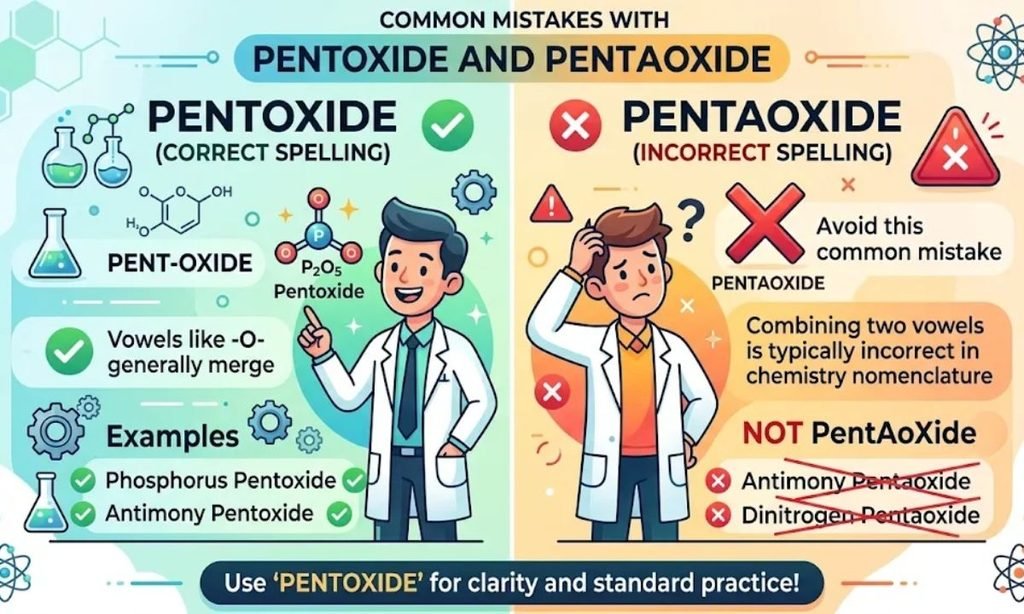
These slips are normal. Chemistry naming has more than one set of rules, so even experienced students mix them up.
Mistake 1: Treating one spelling as an error.
Incorrect: “Pentaoxide is wrong, so I marked it off.”
Correct: “Pentaoxide follows IUPAC 2005 recommendations, so I accepted it.”
Both forms are valid. Grade or edit based on the convention the assignment uses.
Mistake 2: Mixing styles in one document.
Incorrect: “Dinitrogen pentoxide and dinitrogen tetraoxide are both oxides of nitrogen.”
Correct: “Dinitrogen pentoxide and dinitrogen tetroxide are both oxides of nitrogen.” (or use pentaoxide and tetraoxide together)
Consistency matters more than which style you choose.
Mistake 3: Writing it as two words.
Incorrect: “Vanadium penta oxide”
Correct: “Vanadium pentoxide”
The prefix attaches directly to oxide. Never separate them.
Mistake 4: Dropping the prefix on the first element when it is needed.
Incorrect: “Phosphorus pentoxide has the formula P2O5.”
Correct: “Diphosphorus pentoxide has the formula P2O5.”
This one is a gray area. Many sources accept the shorter “phosphorus pentoxide” as a traditional name, but the fully systematic name includes di- to show two phosphorus atoms.
Related Terms: Tetroxide, Monoxide, Heptoxide, and More
The same vowel question appears with other prefixes before oxide:
| Prefix | Traditional (elided) | IUPAC 2005 (kept) | Example |
| mono- | monoxide | monoxide (allowed exception) | carbon monoxide (CO) |
| tetra- | tetroxide | tetraoxide | osmium tetroxide (OsO4) |
| penta- | pentoxide | pentaoxide | dinitrogen pentoxide (N2O5) |
| hepta- | heptoxide | heptaoxide | dimanganese heptoxide (Mn2O7) |
Prefixes that end in a different letter do not have this issue. Di- and tri- give dioxide and trioxide, with no vowel clash to fix.
Other related terms worth knowing: oxide, binary compound, multiplicative prefix, Stock system, molecular formula, and empirical formula. If you want the quickest route, remember that anything ending in “-oxide” with a number prefix follows this same pattern.
FAQ’s
Is pentoxide spelled correctly?
Yes. Pentoxide is a standard, widely used spelling in chemistry. It is the traditional form in textbooks and industry.
Is pentaoxide a real word?
Yes. Pentaoxide is the spelling the 2005 IUPAC Red Book supports for formal systematic names, because it keeps the full prefix penta-.
What is the difference between pentoxide and pentaoxide?
There is no difference in meaning. Both name a compound with five oxygen atoms. The difference is only whether the final “a” in penta- is dropped before oxide.
Which spelling do most chemists use?
Most textbooks, supplier catalogs, and safety documents use pentoxide. Pentaoxide appears mainly where strict IUPAC style is applied.
How do I use pentoxide in a sentence?
Example: “Vanadium pentoxide is used as a catalyst in sulfuric acid production.” Write it as lowercase, with no space between penta and oxide.
Conclusion
Both spellings are legitimate, and both mean “five oxygen atoms.” Use pentoxide for everyday chemistry and most coursework. Use pentaoxide when you are following IUPAC 2005 naming to the letter.
If you remember one thing, make it this: pick a convention, check what your audience expects, and stay consistent from the first line to the last.

Alex Jhon is the admin of Swift Timely, passionate about English grammar, word comparisons, vocabulary, and helping readers improve their language skills with clear, simple explanations.
1 thought on “Pentoxide vs Pentaoxide: Which Spelling Is Correct in Chemistry?”