


You typed a sentence like “I had no intension of hurting you,” and something looked off. Intention and intension look almost identical and sound exactly alike, so the mix-up is easy to make. In everyday writing, intention is the word you want. Intension is a real word, but it belongs to logic and philosophy. Here is how to tell them apart.
Which Is Correct, Intention or Intension?
Intention is the correct word for plans, goals, and purposes. Intension is a separate, specialized word used in logic, philosophy, and semantics to mean the set of qualities that define a concept.
If you mean “what I planned to do” or “what I meant,” write intention. If you are discussing how a term is defined by its properties, you may need intension. Outside of those technical fields, you will almost never need it.
Both words are nouns, and neither is a misspelling of the other. They are different words that happen to look and sound alike.
What Does Intention Mean?
Intention is a noun meaning a plan, aim, or purpose, the thing you mean to do or achieve. It is one of the most common words in this family.
Here are the main ways people use it:
- A goal or plan: “My intention is to finish the report by Friday.”
- A reason behind an action: “Her intention was to help, not criticize.”
- A person’s attitude toward something: “He made his intentions clear.”
- Romantic or personal motives: “What are your intentions with my sister?”
The plural is intentions, and it often appears in phrases like “good intentions” or “best intentions.” The word works in casual conversation, workplace emails, and academic papers.
What Does Intension Mean?
Intension is a noun used mainly in logic, philosophy, and linguistics. It refers to the meaning of a term as defined by its attributes, as opposed to the list of things the term applies to.
Take the word “bachelor.” Its intension is something like “an unmarried adult man.” Its extension is every actual person who fits that description. Intension is the definition. Extension is the collection.
Is intension a real word or just a typo? It is a real word, and dictionaries list it. Some also record an older, rare sense meaning intensity or strength, but modern writers use intensity for that idea.
The plural is intensions, and the adjective is intensional, which is a different word from “intentional.”
Intention vs Intension: Quick Comparison Table
| Term | Correct? | Meaning | Typical Use |
| Intention | Yes | A plan, aim, or purpose | Everyday speech, business, school, law |
| Intension | Yes, but specialized | The defining qualities of a concept | Logic, philosophy, semantics |
| “No intension of…” | No | Not a standard phrase | Replace with “no intention of…” |
| “Good intensions” | No | Not a standard phrase | Replace with “good intentions” |
The table shows the pattern: when the context is ordinary life, the answer is intention.
Are Intention and Intension Pronounced the Same?
Yes. Both words are pronounced the same way in American English: in-TEN-shun. The stress falls on the middle syllable, and the ending sounds like “shun.”
Words that sound alike but have different spellings and meanings are called homophones. That is why you cannot rely on your ear to pick the right spelling. You have to know the meaning.
This is also why the mistake shows up more often in writing than in speech. When you say the word out loud, nobody can tell which one you meant.
Read Related Post: Pentoxide vs Pentaoxide: Which Spelling Is Correct in Chemistry?
Where Do Intention and Intension Come From?
Both words trace back to the Latin verb intendere, which means to stretch toward, aim, or direct attention. That shared root explains why the two words look so similar.
Intention came into English through Old French and carries the idea of “aiming at something,” which is why we use it for purposes and goals. Intension developed along a different path, from related Latin forms, and kept the sense of straining or intensity before taking on its logical meaning.
You can see the family resemblance in other words: intend, intent, intense, tension, and extension all grow from the same Latin soil. When two words share a parent, they often end up looking like twins.
How Do You Use Intention in a Sentence?
Use intention whenever you are talking about purpose or plans. These examples cover different settings:
Everyday conversation: “I had every intention of calling you back, but my phone died.”
Workplace email: “Our intention is to launch the update in March, pending approval.”
Academic writing: “The author’s intention in the final chapter is to challenge the reader’s assumptions.”
Formal writing: “The committee announced its intention to review the policy.”
Casual writing: “No bad intentions here, just curious!”
Notice that “intention” works with prepositions like of, to, and in. You can have the intention of doing something, or an intention to do something. Both patterns are correct.
In the second example, “intention” refers to a plan the company holds, which is exactly the “purpose” sense. In the last example, the plural “intentions” signals motives.
How Do You Use Intension in a Sentence?
Intension appears in technical discussions. These examples show how it typically works:
Philosophy class: “The intension of the word ‘triangle’ is a closed shape with three straight sides.”
Linguistics paper: “The paper distinguishes between a term’s intension and its extension.”
Logic textbook: “Two terms can have different intensions but the same extension.”
In the last example, “the morning star” and “the evening star” are the classic illustration. They have different intensions (different descriptions), yet both point to the same object, the planet Venus.
If you are not writing for a philosophy, logic, or linguistics audience, you can skip this word entirely.
What Are the Most Common Intention and Intension Mistakes?
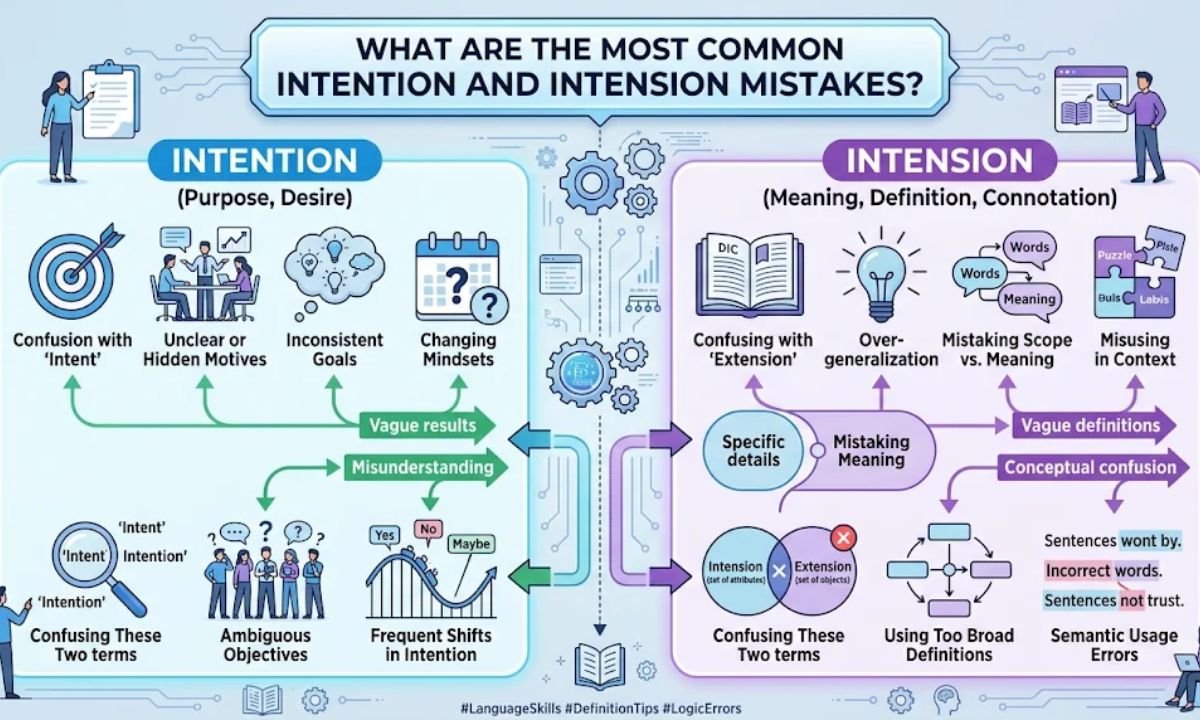
Everyone makes spelling mistakes with look-alike words. Here are the ones people run into most often.
Mistake 1: Using intension for a plan or purpose
Incorrect: I had no intension of leaving early.
Correct: I had no intention of leaving early.
The sentence is about what you planned, so you need intention.
Mistake 2: Spelling the plural wrong in common phrases
Incorrect: She always has good intensions.
Correct: She always has good intentions.
“Good intentions” is a fixed phrase about motives. Intensions would change the meaning to something technical.
Mistake 3: Mixing up intensional and intentional
Incorrect: The error was intensional.
Correct: The error was intentional.
“Intentional” means done on purpose. “Intensional” is a logic term and almost never fits ordinary writing.
Mistake 4: Using intention when you mean intensity
Incorrect: The intention of the heat was unbearable.
Correct: The intensity of the heat was unbearable.
This one goes the other way. If you mean strength or force, the word is intensity.
None of these mistakes mean you are bad at English. Spellcheck often misses them because both words are real, so your software sees nothing wrong.
What Are the Related Forms: Intent, Intend, Intentional, and Intensional?
Intention belongs to a whole word family. Knowing the other forms makes the right choice easier.
- Intend (verb): “I intend to apply next week.”
- Intent (noun or adjective): “She read the contract with careful intent.” / “He was intent on winning.”
- Intentional (adjective): “The pause was intentional.”
- Intentionally (adverb): “He intentionally left the door open.”
- Unintentional and unintentionally: the opposites, meaning accidental or by accident.
Intension has a smaller family:
- Intensional (adjective): relating to intension in logic.
- Intensions (plural noun).
A few common phrases use intention: “good intentions,” “with the intention of,” “have no intention of,” and “declaration of intent.” The proverb about good intentions paving the road to a bad place is a favorite, and it uses intentions, never intensions.
Don’t confuse these with intense and intensity, which describe strength or force, as in “intense pressure.”
How Can You Remember Which Spelling to Use?
Try this simple test: ask whether you mean a plan. If you could swap in the word “purpose” or “aim,” write intention.
Another trick is to connect intention with intend. Both have the letters “nt” followed by “ent” in the middle: in-tent-ion, in-tend. If the sentence has a related verb “intend,” the noun is intention.
For intension, link it with extension, since the two are paired in logic. If your sentence mentions extension, intension may be the right partner. If it does not, you almost certainly need intention.
FAQ’s
Is “intension” a misspelling of “intention”?
No. Intension is a separate word with its own meaning in logic and philosophy. However, in ordinary writing, using intension where you mean “plan” or “purpose” is a mistake.
Which one should I use in an email or essay?
Use intention. Unless your topic is formal logic or semantics, intension will not be the word you need.
What is the plural of intention?
The plural is intentions, as in “good intentions.” The plural of intension is intensions, but it is rarely used outside technical writing.
What is the difference between intension and extension?
Intension is the set of qualities that define a term. Extension is the set of things the term refers to. For “bird,” the intension includes “warm-blooded, feathered, egg-laying,” and the extension is every bird that exists.
Conclusion
Intention and intension sound the same, share a Latin ancestor, and look like typos of each other. Still, they work in different worlds. Intention covers plans, goals, and motives, which is nearly everything you will write. Intension is a specialist term for defining concepts.
When in doubt, remember this: if you could say “plan” or “purpose,” spell it with a t, as in intention.

Alex Jhon is the admin of Swift Timely, passionate about English grammar, word comparisons, vocabulary, and helping readers improve their language skills with clear, simple explanations.
1 thought on “Intention vs Intension: Which Is Correct?”