


You type a word, pause, and wonder: encode or incode? The confusion is understandable. “En” and “in” sound almost identical in fast speech, and English has several word pairs that differ only by those prefixes. The answer is simple: encode is the correct spelling. Incode is not a standard English word, though it shows up as a brand name.
Encode or Incode: What Is the Short Answer?
Encode is the correct word. Incode is not a standard English word. Encode is a verb that means to convert information into a code, a format, or a set of symbols.
If you see “incode” in a sentence, one of three things is happening:
- It is a misspelling of encode.
- It is a company or product name (capitalized as Incode).
- It is a typo for the two-word phrase “in code.”
Everything else in this article explains how to tell those cases apart.
What Does Encode Mean?
Encode has three main senses, and all of them involve turning something into another form.
1. Converting a message into code. This is the classic meaning. You take plain information and rewrite it using a system of symbols.
The students learned to encode simple messages using a number for each letter.
2. Converting data into a specific format. This is the most common meaning in technology writing.
Our video team will encode the footage in a smaller file size before uploading.
3. Representing information in a biological or mental system. Scientists say genes encode proteins, and psychologists say the brain encodes memories.
Researchers found that sleep helps the brain encode new vocabulary.
In every sense, encode needs an object. You always encode something.
Is Incode a Real Word?
No, not as a standard English word. You will not find incode listed as a headword in standard dictionaries. If you use it as a verb in a school paper, a business email, or a report, readers will see it as a spelling error.
There are only a few legitimate situations where “incode” appears:
- As a proper name. Incode is the name of a technology company, so it is correctly written with a capital I when you mean that company.
- As a username, product name, or file name. Developers sometimes pick names like “incode” because they are short and available.
- As a typo for “in code.” Two separate words are perfectly correct when you mean “inside the code” or “written in code.”
Please add a comment in code so the next developer understands this function.
Here “in” is a preposition and “code” is a noun. They belong together as two words, but they are not the verb encode.
Why Do People Confuse Encode and Incode?
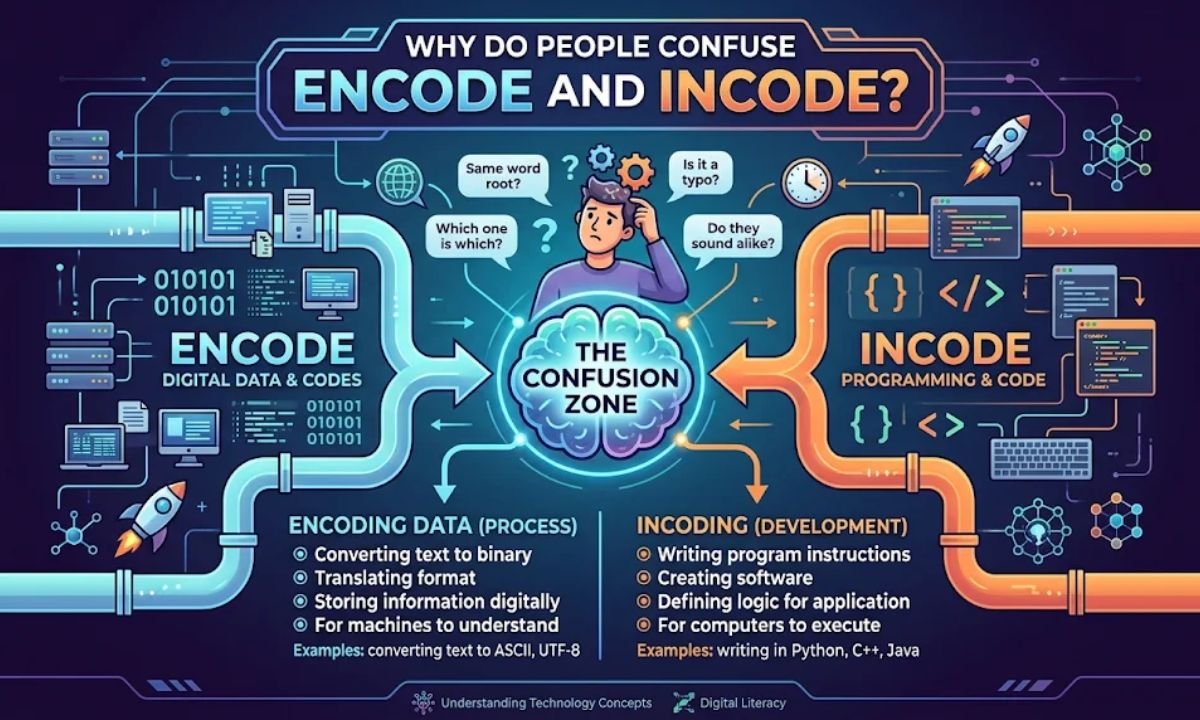
Two reasons explain most of the mix-ups.
First, pronunciation. In everyday American speech, the first syllable of encode is often relaxed, so it can sound like “in-KOHD.” Your ear hears “in,” and your hand types “in.”
Second, English really does have some pairs with both prefixes. Think of enclose and inclose, or enquire and inquire. The prefixes en- and in- both come from the same Latin source and both can mean “into,” so the pattern feels familiar. In those pairs, however, one spelling usually became the standard form over time. For this word, the standard form is encode, and no accepted “incode” variant exists.
Encode vs Incode Comparison Table
| Term | Correct? | Meaning | Use |
| encode | Yes | To convert information into a code or format | Verb, base form |
| encodes | Yes | Third person singular present | “She encodes each file.” |
| encoded | Yes | Past tense, past participle, or adjective | “an encoded message” |
| encoding | Yes | Present participle, gerund, or noun | “the encoding of the file” |
| in code | Yes (two words) | Inside the code, or written in code | “stored in code” |
| Incode | Only as a proper name | A company or brand | Capitalized, names only |
| incode | No | Not a standard word | Replace with encode or in code |
What Part of Speech Is Encode, and What Are Its Forms?
Encode is a transitive verb. That means it takes a direct object: you encode a message, a file, or a signal. You cannot simply “encode” with nothing after it in most sentences.
Here are its forms:
- encode: base form (“We encode every file.”)
- encodes: third person singular (“The system encodes the data.”)
- encoded: past tense and past participle (“They encoded the message.”)
- encoding: present participle and gerund (“She is encoding the video.”)
Related parts of speech include the noun encoder (a person or device that encodes) and the adjective encoded (“an encoded signal”). Encoding also works as a noun: “The encoding of this file is UTF-8.”
Writers often use prepositions with encode in three patterns: encode X as Y, encode X in Y, and encode X into Y.
The app will encode your photos as JPEG files.
Spelling is the same in American and British English, so you do not need to worry about regional differences here.
Read Related Post: Intention vs Intension: Which Is Correct?
How Do You Pronounce Encode?
Encode has two syllables, and the stress falls on the second one: en-KOHD. In phonetic terms, it is roughly /ɛnˈkoʊd/, and many speakers reduce the first vowel to /ɪn/.
The second syllable rhymes with “road,” “load,” and “node.” The final “e” is silent, and it makes the “o” long.
If you hear someone say “in-KOHD,” they are not saying a different word. They are just relaxing the first vowel. The spelling stays the same.
Where Does the Word Encode Come From?
Encode is built from two parts: the prefix en- and the word code.
The word code traces back through Old French to the Latin codex, which originally referred to a wooden writing tablet and later to a book, especially a book of laws. That legal sense explains why we still say “legal code” or “building code.” Over time, code also came to mean a system of signals or symbols used to send messages.
The prefix en- comes through French from Latin in, meaning “in” or “into.” So encode literally means “to put into code.” That is useful to remember, because it shows why the en- spelling is built into the word’s history. The prefix is attached to code, and no separate word “incode” ever developed alongside it.
How Do You Use Encode in a Sentence?
The best way to learn a verb is to see it in different settings.
Everyday conversation:
My brother and I used to encode our notes with a secret alphabet.
Workplace email:
Could you encode the training video in a smaller format before we send it to the client?
Here, “encode” means converting the video file into a different format. The sentence is polite and clear.
Academic writing:
Studies suggest that people encode information more effectively when they connect it to something they already know.
The verb works well in scientific writing because it describes how the brain stores information.
Technical writing:
The server will encode special characters in the URL so the link works correctly.
Casual writing:
I tried to encode a message for my friend, but she cracked it in two minutes.
Passive voice, when the actor does not matter:
The data is encoded before it leaves the device.
Active voice is usually clearer, but the passive works when the system, not a person, is the focus.
What Are Common Mistakes With Encode and Incode?
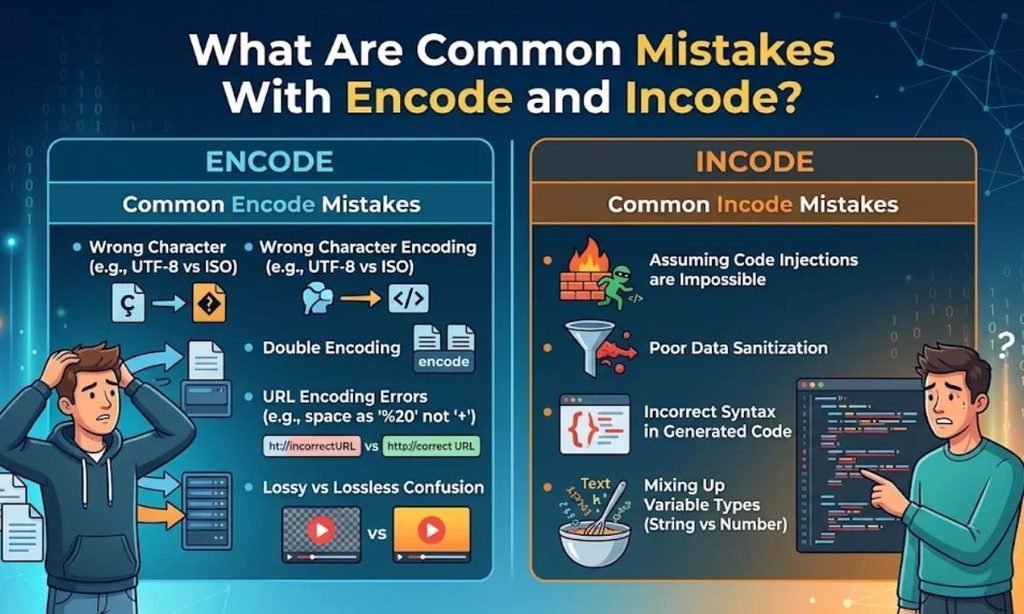
Every one of these mistakes is normal, and each is easy to fix.
Mistake 1: Spelling the verb with “in.”
Incorrect: Please incode the message before you send it.
Correct: Please encode the message before you send it.
The verb always starts with en-.
Mistake 2: Using the wrong past tense.
Incorrect: The files were incoded in UTF-8.
Correct: The files were encoded in UTF-8.
Encoded is the past participle. The same spelling rule applies to every form.
Mistake 3: Using encode as a noun.
Incorrect: The encode of the file failed.
Correct: The encoding of the file failed.
Encode is a verb. When you need a noun, use encoding.
Mistake 4: Writing “in code” as one word.
Incorrect: The password rules are stored incode, not in settings.
Correct: The password rules are stored in code, not in settings.
When “in” is a preposition meaning “inside,” keep it as a separate word.
A simple memory tip: think of the opposite word, decode. Nobody writes “indecode.” Encode pairs with decode, and both look like cousins of encrypt and enclose. If you can picture “en” at the front, you are safe.
What Words Are Related to Encode?
Knowing the neighbors of a word helps you choose it with confidence.
- Decode: the opposite of encode. You decode a message to read it.
- Decipher: to figure out the meaning of something written in code or unclear writing.
- Encrypt: to scramble information so only authorized people can read it.
- Encoder and decoder: the tools or people who perform each task.
- Character encoding: a system, such as UTF-8, that tells a computer how to display text.
- Convert, translate, transcribe: looser synonyms, depending on the context.
The pair people confuse most often is encode and encrypt. Encoding changes the format of information so it can be stored, transmitted, or understood by a system. Encryption hides information so only someone with a key can read it. If someone can reverse the change without any secret, it is encoding, not encryption.
Base64 encoding makes a file safe to send in an email, but it does not make the file private.
FAQ’s
Is incode a correct spelling?
No. The verb is spelled encode. Incode appears only as a brand or product name, and “in code” is correct as two words when you mean “inside the code.”
What does encode mean?
Encode means to convert information into a code, a symbol system, or a specific format. It also describes how genes carry instructions for proteins and how the brain stores memories.
How do I use encode in a sentence?
Use it with an object, and add a preposition if you want to name the result: “We encode each file as a PDF before sending it.” You can also say, “The sender encoded the message in numbers.”
What is the difference between encode and encrypt?
Encoding changes information into another format for storage, transmission, or compatibility, and anyone with the right method can reverse it. Encryption protects information with a secret key so unauthorized people cannot read it.
Can I write “in code” as two words?
Yes, and often you should. “In code” is a normal prepositional phrase meaning “within the code” or “written in code.” It is simply a different thing from the verb encode.
Conclusion
Use encode whenever you mean to convert information into a code or format. Use in code (two words) when you mean “inside the code,” and use Incode only when you are naming the company. If you are ever unsure, remember that encode is the partner of decode, and the en- at the front is part of the word’s identity.

Alex Jhon is the admin of Swift Timely, passionate about English grammar, word comparisons, vocabulary, and helping readers improve their language skills with clear, simple explanations.
1 thought on “Encode vs Incode: Which Is Correct and When Should You Use Each?”