


Rug and rag look almost identical on the page, and one tiny vowel swap changes everything. People mix them up when typing fast or when a spellchecker silently approves the wrong one.
Here is the quick answer for rug vs rag: a rug is a floor covering, and a rag is a scrap of cloth used for cleaning or wiping. Both are correct words. They just do different jobs.
What Is the Difference Between a Rug and a Rag?
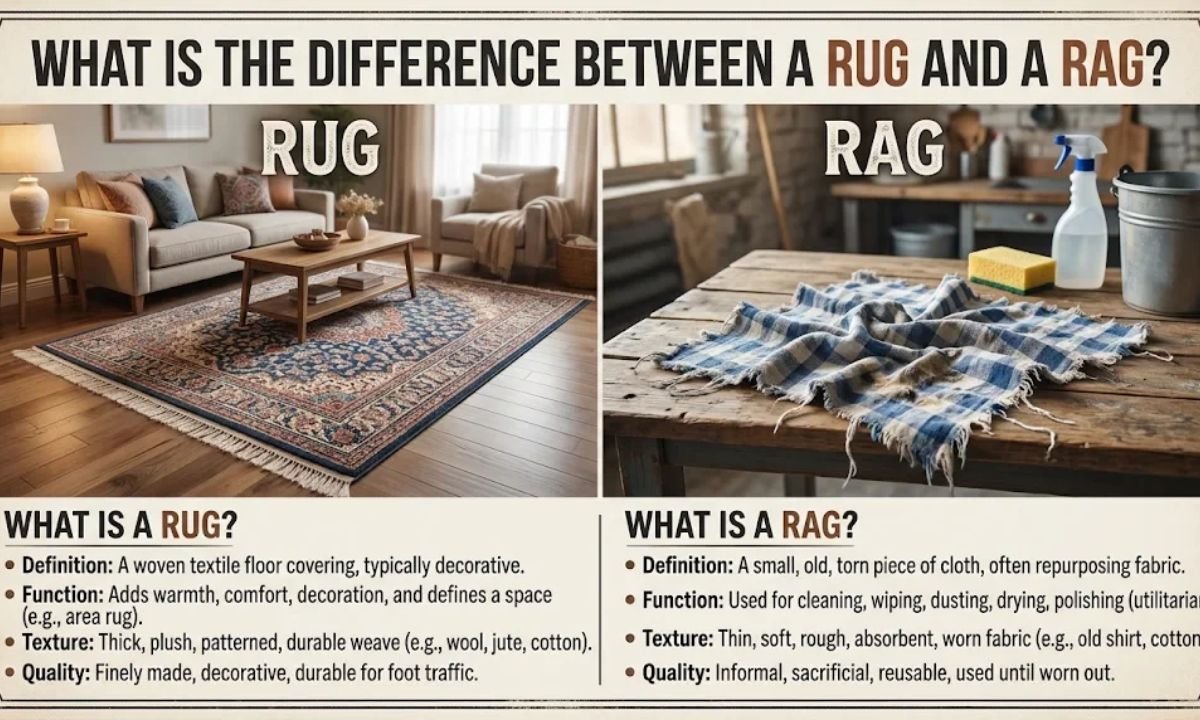
A rug is a piece of thick fabric or material that covers part of a floor. A rag is a torn, worn, or leftover piece of cloth, usually used for cleaning, wiping, or polishing.
That is the whole core distinction. You walk on a rug. You wipe a spill with a rag.
Neither word is a misspelling of the other. Each has its own meaning, its own pronunciation, and its own set of phrases. The confusion comes almost entirely from how similar they look and sound.
What Does Rug Mean?
Rug is a noun. In everyday American English, it most often means a decorative or protective covering for part of a floor, smaller than wall-to-wall carpet.
Common kinds include area rugs, throw rugs, runner rugs, and bath rugs. Rugs can be woven, tufted, braided, or made from wool, cotton, jute, or synthetic fibers.
A few other meanings are worth knowing:
- A rug can be a thick animal skin used as a floor covering, such as a sheepskin rug.
- In British English, a rug can also be a blanket, as in a “travel rug” or “picnic rug.”
- In slang, a rug can be a toupee or wig. This use is informal and often humorous.
Example: We bought a new rug for the living room because the hardwood floors were loud.
What Does Rag Mean?
Rag is also mainly a noun. Its most common meaning is a piece of old, torn, or cut-up cloth used for cleaning, dusting, or wiping.
Garages, kitchens, and workshops are full of rags. A rag is usually soft, absorbent, and expected to get dirty. Nobody frames one and hangs it on a wall.
Rag has several other meanings:
- Rags (plural) can mean old, tattered clothing.
- In informal speech, a rag can be a low-quality newspaper or tabloid.
- As a verb, to rag on someone means to tease or criticize them.
- In music, a rag is a short form of ragtime, a style of piano music.
Example: Grab a clean rag and wipe the oil off the dipstick.
Rug vs Rag Comparison Table
| Term | Part of Speech | Meaning | Typical Use |
| Rug | Noun | A floor covering, or in British English a blanket | Decorating, warming, or protecting floors |
| Rag | Noun, verb | A scrap of cloth, tattered clothing, or (informally) a tabloid | Cleaning, wiping, polishing |
| Rag rug | Noun | A rug made from strips of fabric or old rags | Craft projects, rustic decor |
Both words are fully standard English. Only the context decides which one fits.
How Do You Pronounce Rug and Rag, and What Are Their Word Forms?
The only difference in sound is the vowel.
- Rug rhymes with bug and hug. The vowel is a short “uh” sound.
- Rag rhymes with bag and flag. The vowel is a short “a” sound, like the one in cat.
For plurals, both just add an s: rugs and rags.
Rag also works as a verb, and this is where the two words differ in grammar. The forms are rag, rags, ragged, ragging. For example: My brothers ragged on me for an hour about my haircut.
Rug is almost always a noun in modern American English. You will not hear “I rugged the floor” in normal speech.
Rag has a related adjective too. Ragged (pronounced RAG-id when it means tattered) describes something torn or worn, as in a ragged coat. Rug has no common matching adjective.
Read Related Post: Encode vs Incode: Which Is Correct and When Should You Use Each?
Where Do the Words Rug and Rag Come From?
Dictionaries generally trace both words to Scandinavian roots, though the exact paths are not fully certain. Rug first referred to a rough, coarse fabric and later to a bed covering. Using it for a floor covering came later. Rag likely connects to older words for tufts or shaggy pieces.
I am keeping this section short on purpose. Etymology for small, old words is often debated, and the practical meanings matter more here than a speculative family tree.
One useful takeaway: both words began with the idea of rough, shaggy cloth. That shared past helps explain why rag rugs exist, which we will cover below.
When Should You Use Rug and When Should You Use Rag?
Ask one simple question: will it go on the floor to be walked on, or will it be used to wipe something?
Use rug when you mean:
- A floor covering in a home or office
- A decorative woven or tufted piece
- A travel or picnic blanket, if you are writing British English
Use rag when you mean:
- A cleaning cloth
- A scrap of fabric
- Torn or worn clothing (usually plural)
- A tabloid newspaper, in informal or critical writing
If you are unsure, think about the object itself. If it has a pattern, a border, and a price tag in a home store, it is a rug. If it is gray, stained, and soaked with cleaner, it is a rag.
Real Life Examples of Rug and Rag in Sentences
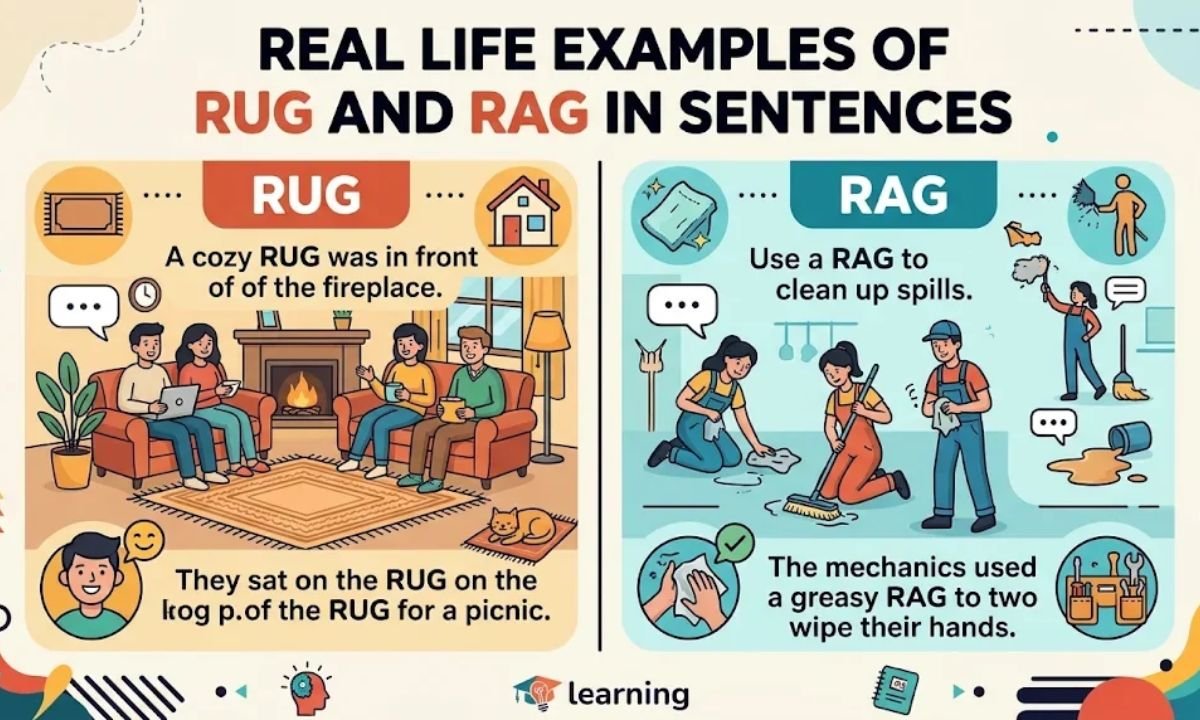
Seeing both words in context makes the difference stick.
Everyday conversation
- Can you pull the rug straight? The corner is curling up.
- Toss me that rag, please. I spilled coffee.
Workplace communication
- Facilities will replace the entry rug on Monday because it is a trip hazard.
- Please keep a rag at each workstation to wipe down equipment after use.
Emails
- Thanks for the quick fix. The new rug under the conference table looks great.
- I left the cleaning rags in the supply closet on the second floor.
Academic and formal writing
- The museum displayed a seventeenth-century Persian rug woven in silk and wool.
- The novel opens with a boy in rags, standing outside a closed bakery.
The last sentence uses the plural rags to mean tattered clothing, not cleaning cloths. That is a common literary use and fully correct.
Casual writing
- The cat has claimed the new rug as her personal throne.
- I’m not reading that rag. It’s all celebrity gossip.
In the last example, rag is a slightly insulting word for a low-quality newspaper or magazine.
What Are the Most Common Rug and Rag Mistakes?
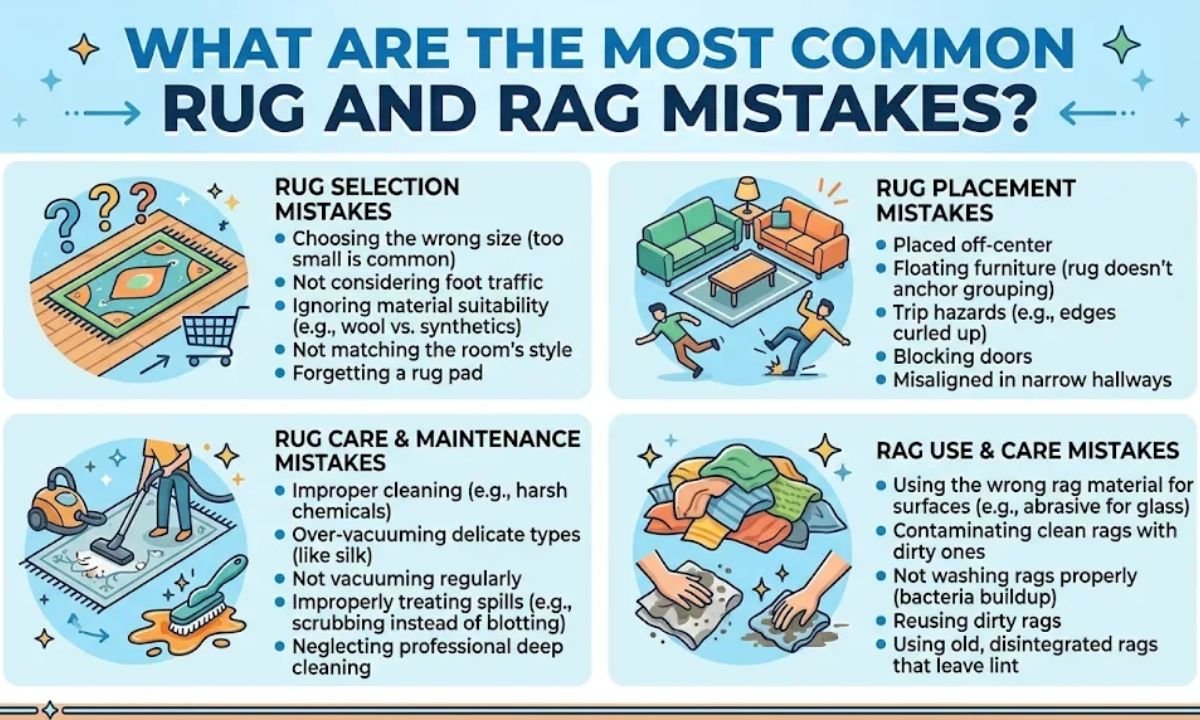
These mix-ups are normal, especially when typing quickly. Here are the ones that appear most often.
Mistake 1: Using rag for a floor covering
Incorrect: We put a new rag in the hallway.
Correct: We put a new rug in the hallway.
A hallway covering is a rug, or a runner. A rag would be a cleaning cloth.
Mistake 2: Using rug for a cleaning cloth
Incorrect: Wipe the counter with a clean rug.
Correct: Wipe the counter with a clean rag.
Unless you are being very rude to your living room, you do not wipe a counter with a rug.
Mistake 3: Mixing up the idioms
Incorrect: The news swept the whole scandal under the rag.
Correct: The news swept the whole scandal under the rug.
Idioms are fixed. The one about hiding a problem uses rug.
Mistake 4: Writing “rag-tag” with the wrong second word
Incorrect: a rug-tag group of volunteers
Correct: a ragtag group of volunteers
Ragtag describes a messy, mismatched group. It comes from rag, not rug.
What Are Common Idioms and Related Terms for Rug and Rag?
Both words appear in well-known expressions. Learning them also helps you avoid the mix-ups above.
Idioms with rug
- Sweep something under the rug: hide a problem instead of dealing with it.
- Pull the rug out from under someone: suddenly remove support or surprise them.
- Cut a rug: dance energetically (informal, a bit old-fashioned).
- Snug as a bug in a rug: very comfortable and cozy.
- Rug rat: a playful term for a small child.
Idioms and phrases with rag
- Rags to riches: going from poverty to wealth.
- Chew the rag: chat at length (informal).
- Glad rags: your best clothes (informal, somewhat dated).
- Lose your rag: lose your temper (mainly British English).
- Rag on someone: tease or criticize.
- Ragtag: disorganized or mismatched.
- Rag doll: a soft doll made from cloth.
Related terms
- Carpet: usually covers an entire floor, while a rug covers part of it. In everyday talk, people often use the words loosely.
- Mat: a small, functional rug, such as a doormat or yoga mat.
- Cloth, towel, or wipe: common synonyms for rag.
- Rag rug: a rug made from strips of fabric, which is the one place where both words meet.
How Can You Remember the Difference Between Rug and Rag?
Try one of these quick tricks.
- Rug has a “u” like “underfoot.” It sits under your feet.
- Rag has an “a” like “wipe away.” You use it to clean up messes.
- Rug rhymes with hug. Rugs feel soft and cozy.
- Rag rhymes with bag. Rags often end up in a cleaning bag or bucket.
When writing quickly, pause on any sentence about the floor or about cleaning. Those two contexts almost always decide the right word.
FAQ’s
Is a rug the same as a rag?
No. A rug is a floor covering, and a rag is a scrap of cloth, usually used for cleaning. The two words are not interchangeable. The exception is rag rug, a rug made from rag-like fabric strips.
Can a rag be used as a rug?
Sometimes, in a craft sense. A rag rug is made by braiding, weaving, or hooking strips of fabric into a floor covering. A single cleaning rag laid on the floor is still just a rag.
What does “lose your rag” mean?
It means to lose your temper. This phrase is mainly British English. Americans are more likely to say “lose it” or “lose my cool.”
How do I use rug and rag in the same sentence?
I put a rug in the entryway, and I keep a rag nearby to wipe muddy boots.
Is “rug” ever slang for hair?
Yes. In informal speech, a rug can be a toupee or wig. It is a joking term and not polite in serious conversation.
Conclusion
A rug goes on the floor. A rag goes in your hand for wiping and cleaning. If you are describing something people walk on, choose rug. If you are describing a scrap of cloth, tattered clothing, or a cleaning cloth, choose rag.
One last memory aid: you sweep a problem under the rug, and you wipe a mess with a rag.

Alex Jhon is the admin of Swift Timely, passionate about English grammar, word comparisons, vocabulary, and helping readers improve their language skills with clear, simple explanations.
1 thought on “Rug vs Rag: What Is the Difference?”