


Many people see both spellings on storage ads and military forums and wonder which is right. The confusion comes from the double n in “connect,” which makes “connex” look like a natural spelling.
The answer is simple: “conex” is the standard spelling, and “connex” is a common variant that is not preferred. Both point to the same steel shipping box.
Which Spelling Is Correct, Conex or Connex?
Use “conex.” It is the established spelling of the word, and it comes from “Container Express,” the name of a U.S. Army cargo system.
“Connex” is not a separate word with a separate meaning when people use it for a container. It is a spelling variation. You will see it in casual writing, classified ads, and conversation, and readers will understand it. In careful writing, though, “conex” is the safer choice.
There is one exception. “Connex” is also a name that some companies and organizations use as a brand. In that case, it is a proper noun, and you should spell it exactly as the organization does.
What Does Conex Mean?
“Conex” refers to a CONEX box, a rugged steel container for moving and storing cargo. The term started as a military label and later spread into everyday American English.
In everyday speech, people use it loosely for almost any steel shipping or storage container. Someone might say, “He keeps his tools in a conex behind the barn.” A military veteran, on the other hand, may use the term more precisely for the Army’s original design.
Because the word is short for a system name, it works as a noun. It often appears in the phrase “conex box,” where “conex” works like an adjective.
What Does Connex Mean?
When people write “connex” in place of “conex,” they mean the same thing: a steel shipping container. The extra n does not create a new meaning.
Outside of containers, “connex” shows up mainly as a name. Some businesses and organizations have used it as a brand, and brand names follow their owners’ spelling rather than general grammar rules. If you are writing about a specific company, check how it spells its own name.
Here is the practical takeaway. If you mean a shipping container, “connex” is a variant. If you mean a company, “Connex” may be the correct and only spelling.
Conex vs. Connex: Quick Comparison
| Term | Correct? | Meaning | Best Use |
| Conex | Yes, standard | A steel cargo container, from “Container Express” | Formal writing, ads, military and logistics contexts |
| Connex | Variant spelling | Same container, spelled with a double n | Casual writing, or when it is a brand name |
| CONEX | Yes | The original Army container system and its boxes | Military, historical, and technical writing |
| Conex box | Yes | The container itself | General use |
Notice that the table does not call “connex” a different word. It is better described as a less preferred spelling of the same word.
Read Related Post: Rug vs Rag: What Is the Difference?
Where Does the Word Conex Come From?
“Conex” is a blend of two words: “container” and “express.” The U.S. Army Transportation Corps developed the system in the early 1950s, and the final design took shape in late 1952. It replaced an earlier steel container called the “Transporter.”
The goal was practical. Soldiers could load supplies once, close the container, and move it intact between trucks, trains, and ships. Earlier cargo often traveled in crates, sacks, and barrels, which took far longer to handle.
The system saw heavy use during the Korean and Vietnam wars. After that, the name drifted into civilian life.
One detail often gets mixed up. The original CONEX box is not the same as the modern ISO shipping container. The two are related by idea, but the Army boxes were smaller and built to a different standard. Even so, many people still call modern containers “conexes” out of habit.
Why Do People Add a Second N?
The second n most likely comes from the way people connect the word to “connect,” “connection,” and “connex” style spellings. This is a reasonable guess about why the variant spread, not a documented rule.
Think about how people learn the word. Many first hear it spoken, then try to spell it. In speech, “conex” sounds like KAH-neks, and the double n in “connect” feels familiar. So the brain fills in a second n.
Since “conex” is a clipped form, there is no spelling pattern to lean on. That makes the variant easy to produce and easy to repeat. This is a normal part of how informal words work in English.
How Do You Pronounce Conex and Connex? A Quick Grammar Guide
Both spellings are pronounced the same way: KAH-neks (/ˈkɑːnɛks/). The stress falls on the first syllable. The double n in “connex” does not change the sound.
Here are the main grammar points:
- Part of speech: “Conex” is a noun. In “conex box,” it works as a noun adjunct, which means a noun that modifies another noun.
- Plural: Most writers use “conex boxes.” When the word stands alone, you may see “conexes,” though some writers avoid it because it looks awkward.
- Capitalization: In general writing, use lowercase “conex.” Use all caps, “CONEX,” when you refer to the original Army system or its history.
- Verb forms: None. People do not say “to conex” something in standard English.
- American vs. British usage: The term is much more common in American English. British writers usually say “shipping container” or “storage container.”
How Do You Use Conex in a Sentence?
Here are natural examples in different settings.
Everyday conversation: “We stored the camping gear in a conex out back.”
Workplace email: “The contractor will deliver the conex box to the job site on Monday morning.”
Academic writing: “The Army’s CONEX system helped standardize how supplies moved through the Korean War supply chain.”
Business writing: “Our yard has three conex boxes available for short-term rental.”
Casual writing: “My uncle turned an old conex into a workshop.”
The first example works because “conex” names a physical object, and the sentence needs no extra explanation. The academic example uses capital letters because it refers to the historical military system.
What Are the Most Common Conex and Connex Mistakes?
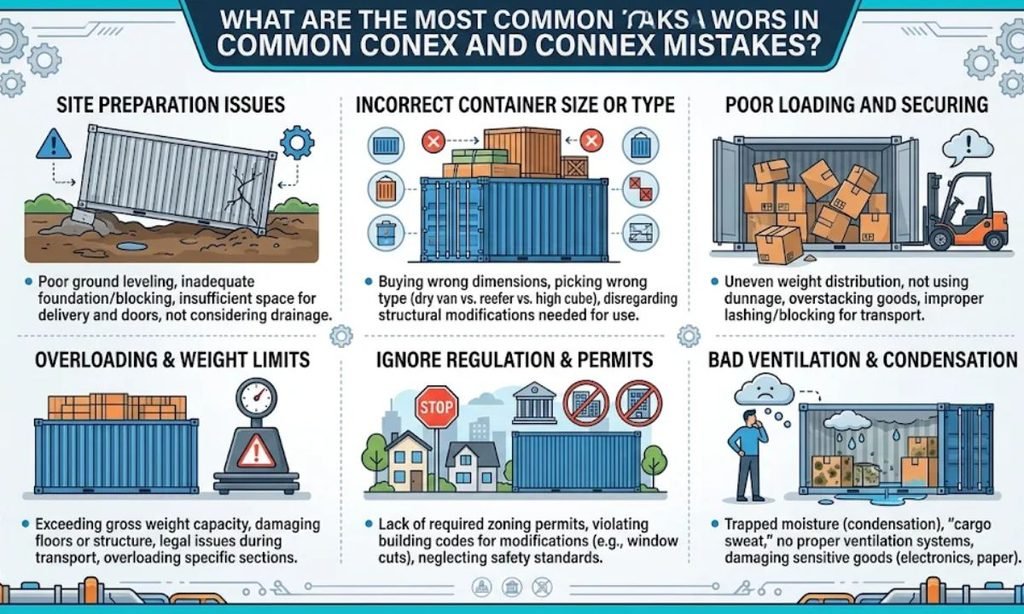
These mistakes are normal, and they are easy to fix.
Mistake 1: Using the double n in formal writing
Incorrect: The company sells used connex boxes.
Correct: The company sells used conex boxes.
The single n is the preferred spelling, so formal and professional writing should use it.
Mistake 2: Treating “conex” as a brand name
Incorrect: I bought a Conex from the hardware store.
Correct: I bought a conex box from a container dealer.
“Conex” began as a descriptive military term, so it is not a brand. Lowercase it in everyday writing.
Mistake 3: Assuming every shipping container is a true CONEX
Incorrect: This 40-foot conex is the original Army design.
Correct: This 40-foot shipping container is often called a conex.
The original CONEX boxes were smaller than modern ISO containers. Casual usage is fine, but precise writing should keep the distinction.
Mistake 4: Changing the spelling of a company name
Incorrect: Connex Rail changed its name. (when the brand is actually spelled differently)
Correct: Always match the organization’s official spelling.
Is a Conex Box the Same as a Shipping Container?
Not exactly, but in everyday American English the two terms are often used for the same thing.
Strictly speaking, a CONEX box is the smaller steel container developed by the Army. A modern shipping container is usually a standardized 20-foot or 40-foot unit made for global freight. People still call these “conexes” because the word is shorter and familiar.
If accuracy matters, use the term that fits your situation:
- Use conex box for casual talk or when you want a familiar word.
- Use shipping container for commercial freight and technical writing.
- Use storage container when the box stays in one place.
- Use CONEX when writing about the Army system or its history.
Which Spelling Should You Use in Different Situations?
Here is a simple guide.
Formal writing, business, and academic work: Use “conex.” It is the standard form.
Casual writing and social media: “Conex” is still better, though “connex” will not confuse anyone.
Product listings and ads: Many sellers include both spellings in listings, so shoppers who search for either form can find them. Your main text should still use “conex.”
Brand names: Follow the company’s own spelling, even if it uses “Connex.”
Military or historical writing: Use “CONEX” in capitals for the original system.
If you are ever unsure, choose the single n. You will be right in almost every situation.
Conex or Connex FAQ
Is connex a real word?
“Connex” is a real spelling that people use, and readers will understand it. It is best treated as a variant of “conex,” and it is also used as a brand name by some organizations.
What does conex stand for?
“Conex” comes from “Container Express,” the name of an Army cargo system developed in the early 1950s.
Is conex capitalized?
In general writing, no. Use lowercase “conex.” Use “CONEX” when you refer to the original military system.
How do you spell the plural of conex?
Most writers use “conex boxes.” The form “conexes” also appears, but “conex boxes” reads more smoothly.
Conclusion
Use conex with one n. It comes from “Container Express,” it matches the established spelling, and it works in nearly every setting. “Connex” is a variant you will see in casual writing and sometimes as a brand name.
One easy way to remember it: “conex” is short for “container express,” and neither word has a double n.

Alex Jhon is the admin of Swift Timely, passionate about English grammar, word comparisons, vocabulary, and helping readers improve their language skills with clear, simple explanations.
1 thought on “Conex or Connex: What Is the Difference?”