


You type a sentence about your new jacket and freeze. Is it “waring” or “wearing”? The two look alike and often sound identical, so the mix-up is common. Here is the quick answer: “wearing” is the correct word for having clothes or accessories on your body. “Waring” is not a standard English word, though it exists as a surname and a place name.
Which Word Is Correct, Waring or Wearing?
Use “wearing” in almost every sentence. “Waring” is only correct when it is a proper noun, such as a person’s last name or the name of a place or brand.
“Wearing” is the present participle of the verb wear. It describes the action of having something on your body, or the slow damage that comes from use.
If you are writing about clothing, glasses, jewelry, perfume, or a smile, the spelling is always w-e-a-r-i-n-g.
What Does “Wearing” Mean?
“Wearing” has several everyday meanings, and all of them come from the verb wear.
Having something on your body. This is the most common use.
- She is wearing a green coat.
- Are you wearing your seat belt?
Showing an expression or look.
- He walked in wearing a huge grin.
Gradually damaging something through use.
- The tires are wearing down faster than expected.
Tiring someone out or testing their patience.
- The long meeting was wearing everyone down.
Each meaning follows from the same idea: something is being carried, shown, or used until it changes.
What Is “Waring,” and When Is It Right?
“Waring” is not listed as an ordinary English word in standard dictionaries. You will see it capitalized, because it works as a proper noun.
The most common uses are:
- A surname, as in “Dr. Waring will see you now.”
- A place name, as in “Waring Hall.”
- A brand name, as in the Waring blender, named for bandleader Fred Waring, who backed the early product.
In each case, the word is capitalized and refers to a specific person, place, or product. If your sentence is about clothing, it is not the right word.
Waring vs Wearing: Quick Comparison Table
| Term | Correct? | Meaning | Use |
| Wearing | Yes | Having on the body, showing, or gradually damaging | Everyday and formal writing |
| Waring | Only as a proper noun | A surname, place, or brand name | Capitalized names only |
| Warring | Yes | Fighting or in conflict | Describes groups at war or in dispute |
The third row matters because “waring” is sometimes a typo for “warring,” which you will meet later in this article.
Why Do People Confuse Waring and Wearing?
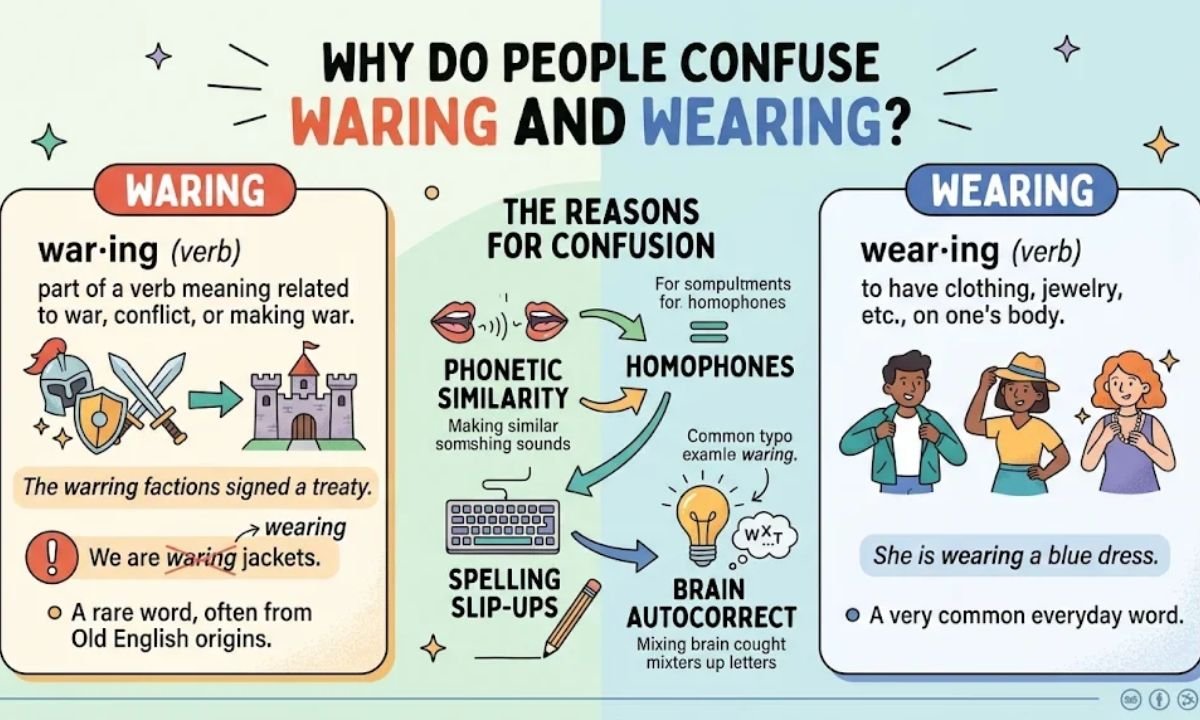
There are three main reasons.
The sounds overlap. In American English, “wearing” and the surname “Waring” are often pronounced the same way. When you hear a word but have not seen it written, you may guess the wrong spelling.
English spelling is inconsistent. The letters “ea” can sound like “ee” (read), “eh” (bread), or “air” (wear, bear). That makes it hard to trust your ear.
The surname is familiar. Many people have seen “Waring” on a kitchen appliance or a street sign. That familiarity can make it look like a normal spelling.
None of this reflects poorly on you. Spelling tricks like this trip up native speakers and learners alike.
Read Related Post: Conex or Connex: What Is the Difference?
How Do You Pronounce Waring and Wearing?
In American English, “wearing” is pronounced WAIR-ing, with the same vowel sound as “caring” and “sharing.”
The surname “Waring” is commonly pronounced the same way in the United States, though some families and regions pronounce it differently. When in doubt, ask the person how they say their name.
“Warring” is a different word. It is usually pronounced WOR-ing, which sounds closer to “boring.” Some American accents blur this difference, so do not rely on your ear alone.
How Does “Wearing” Work Grammatically?
Wear is an irregular verb, so its forms do not follow the usual “add -ed” pattern.
| Form | Example |
| Base form | I wear a watch every day. |
| Third person singular | She wears glasses. |
| Present participle | He is wearing a tie. |
| Past tense | They wore uniforms yesterday. |
| Past participle | I have worn this sweater for years. |
“Wearing” appears in continuous tenses, which describe actions in progress.
- She was wearing sunglasses when I saw her.
- We will be wearing costumes at the party.
It also works as a participle that adds detail to a sentence: “Wearing a blue suit, he stepped up to the podium.”
The word wear comes from Old English werian, meaning to carry on the body. Its basic meaning has stayed remarkably stable for over a thousand years.
How Do You Use “Wearing” in a Sentence?
Here are natural examples from different settings.
Everyday conversation
- “Are you wearing that to dinner?”
- “I forgot I was wearing my slippers.”
Workplace communication
- “Please remember that everyone on the floor must be wearing safety glasses.”
- “I will be wearing a navy blazer so you can spot me at the conference.”
- “I’ll be the one wearing the red scarf near the entrance.”
Academic writing
- “Participants were wearing sensors on their wrists during the test.”
Formal writing
- “Guests are encouraged to attend wearing business formal attire.”
Casual writing
- “Wearing sweatpants to a video call is my superpower.”
In the academic example, “were wearing” is correct because it is a continuous past action. The sensors were on the wrists throughout the test.
What Are the Most Common Waring and Wearing Mistakes?
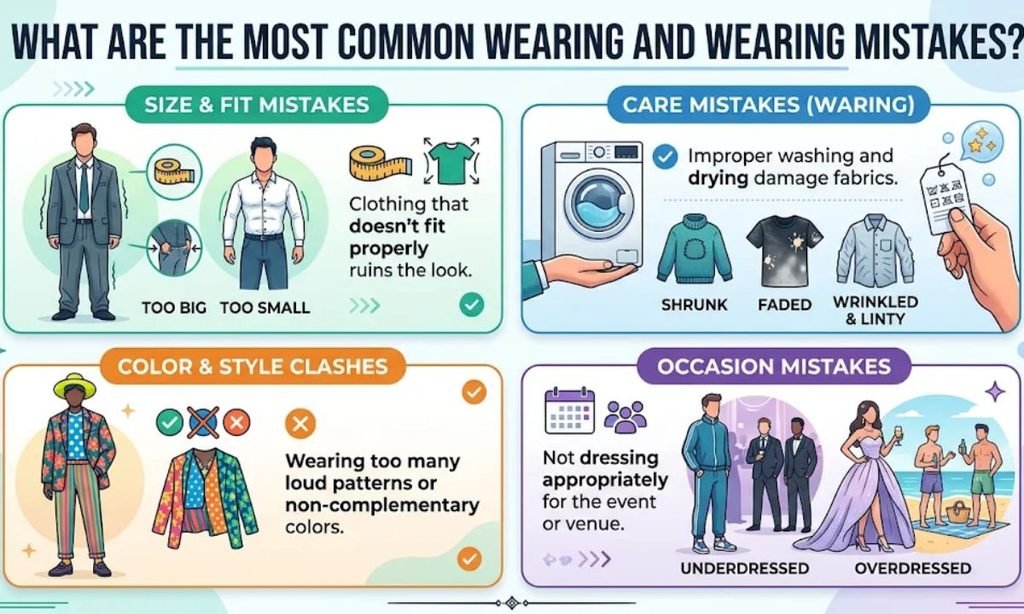
Here are the errors editors see most often.
Mistake 1: Using “waring” for clothing
Incorrect: She was waring a black dress.
Correct: She was wearing a black dress.
The word describing clothing is always “wearing.”
Mistake 2: Using “waring” for conflict
Incorrect: The waring factions reached a ceasefire.
Correct: The warring factions reached a ceasefire.
“Warring” means engaged in conflict. It needs a double r.
Mistake 3: Dropping the “e” in an idiom
Incorrect: His excuses are waring thin.
Correct: His excuses are wearing thin.
“Wearing thin” means losing effectiveness or patience.
Mistake 4: Lowercase surname
Incorrect: I called dr. waring this morning.
Correct: I called Dr. Waring this morning.
When it is a name, “Waring” gets a capital letter.
Each of these mistakes is easy to make, and each is easy to fix once you know the pattern.
Is “Waring” Ever a Misspelling of “Warring” or “Warning”?
Yes, and this explains many of the searches for the word.
Warring is an adjective meaning fighting or in disagreement. Examples include “warring nations,” “warring tribes,” and “warring parties.”
Warning is a noun or verb about alerting someone to danger. A typo can turn “warning” into “waring” if one letter is dropped.
These related spellings and phrases are worth knowing:
- Wear and tear: gradual damage from regular use
- Wearing off: gradually disappearing, as in “the medicine is wearing off”
- Wearing out: becoming useless from use
- Worn out: exhausted or damaged by use
Notice that every one of these uses the root wear, with an e.
How Can You Remember the Right Spelling?
Try these simple memory tricks.
Look for the ear. You wear things on your body, and you have ears on your head. Both words contain “ear.” That connection is a quick check.
Check for the verb. If you can replace the word with “putting on” or “dressed in,” use “wearing.”
Check for a capital. If the word is a name, capitalize it. If it is not a name, “waring” is almost certainly wrong.
Run a spell check, but read carefully. Spell checkers sometimes accept “Waring” because it is a valid name. Look at the context before accepting it.
FAQ’s
Is “waring” a real word?
“Waring” is not a standard English word. It is a real surname, place name, and brand name, and it should be capitalized in those uses.
What does “wearing” mean?
“Wearing” means having something on your body, showing an expression, or gradually damaging something through use. It is the present participle of wear.
How do I use “wearing” in a sentence?
Use it after a form of “to be” to describe an action in progress. For example: “She is wearing her new running shoes.”
Is it “wearing” or “warring”?
They are different words. “Wearing” relates to clothing or gradual damage. “Warring” describes people or groups in conflict, as in “warring neighbors.”
Why does my spell checker accept “Waring”?
Because it is a valid proper noun. A spell checker cannot tell whether you meant a person’s name or the clothing word, so always check the context.
Conclusion
When you are describing clothing, expressions, or gradual damage, the word you want is “wearing.” Save “Waring” for people, places, and brands, and use “warring” when you mean conflict.
If you remember one thing, make it this: you wear things on your body, so “wearing” has an ear in it.

Alex Jhon is the admin of Swift Timely, passionate about English grammar, word comparisons, vocabulary, and helping readers improve their language skills with clear, simple explanations.
1 thought on “Waring vs Wearing: Which Word Is Correct?”