


Seeing “training” and “trainning” side by side can make you doubt yourself. Many English words double a consonant before -ing, so the extra n looks believable. Here is the quick answer: “training” is the correct spelling, and “trainning” is always a misspelling. This guide explains why, what the word means, and how to use it with confidence.
Which Spelling Is Correct, Training or Trainning?
Training is the correct spelling. Trainning is not a word in standard English. You will not find it in major US dictionaries, and it has no legitimate use as a variant spelling.
The word is spelled T-R-A-I-N-I-N-G, with one n in the middle. It comes from the verb train plus the ending -ing. Nothing in that process calls for a second n.
Wrong: She is enrolled in a trainning program.
Right: She is enrolled in a training program.
What Does Training Mean?
Training is the process of teaching or learning the skills, knowledge, or habits needed for a particular job, activity, or goal. It can also mean preparation for a sport or physical challenge.
Most dictionaries and everyday usage point to a few related senses:
- Workplace instruction: onboarding, safety courses, and software lessons.
- Education for a profession: teacher training, medical training, and flight training.
- Physical preparation: marathon training, strength training, and military training.
- Teaching an animal: dog training or horse training.
In all of these, the idea is the same. Someone practices or is taught so they can perform better.
Why Is Trainning Wrong? The Spelling Rule Explained
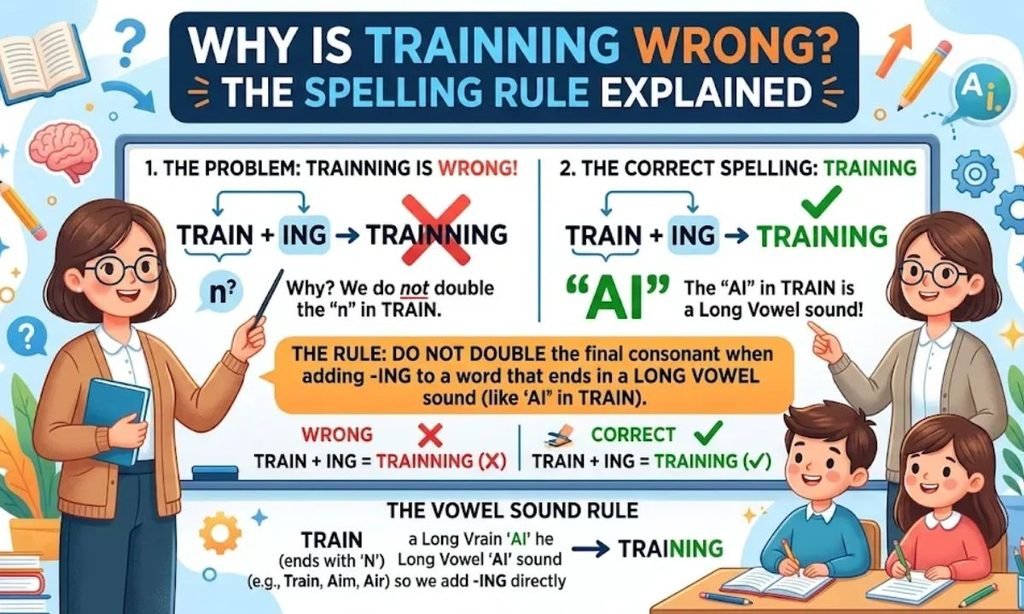
People write “trainning” because of a real spelling rule that applies to other words. The rule just does not apply here.
English often doubles the final consonant before adding -ing, but only under specific conditions. The word usually has one syllable, ends in a single vowel followed by a single consonant, and the vowel is short. Think of run becoming running, stop becoming stopping, and plan becoming planning.
Train does not fit that pattern. It has two vowel letters (a and i) before the final n, and together they make one long vowel sound. When two vowel letters come before the last consonant, you simply add -ing. That is why train becomes training, just as rain becomes raining and remain becomes remaining.
So the extra n in “trainning” breaks the rule instead of following it.
Training vs Trainning at a Glance
This table shows the whole answer in one place.
| Term | Correct? | Meaning | Use |
| Training | Yes | Teaching or learning a skill, or physical preparation | Use in all writing, formal or casual |
| Trainning | No | None (misspelling of training) | Never use; replace with training |
| Traning | No | None (misspelling of training) | Never use; add the missing i |
| Trainings | Yes (with limits) | Separate training sessions or programs | Common in workplace writing in US English |
What Part of Speech Is Training? Noun, Verb, and Adjective Forms
Training works as a noun most of the time. It names the process of learning or teaching a skill. In this meaning it is usually uncountable, so we say “some training” or “a lot of training,” not “a training.”
It also appears as the present participle of the verb train. In that role it forms continuous tenses and describes ongoing action.
- Noun: The training starts at 9 a.m.
- Present participle: We are training new volunteers this week.
- Noun used like an adjective: The company runs a training program every spring.
The full set of forms looks like this:
- Base verb: train
- Third person singular: trains
- Past tense and past participle: trained
- Present participle and gerund: training
- Person doing the training: trainer
- Person receiving it: trainee
American and British English spell the word the same way. The one small difference is in common phrasing. Americans often say “work out” or “workout” for exercise, while “training session” is more common for athletes in both countries.
Read Related Post: Waring vs Wearing: Which Word Is Correct?
How Do You Pronounce Training?
Training has two syllables and is pronounced TRAY-ning. The stress falls on the first syllable.
The first syllable rhymes with day, and the second sounds like ning. The spelling “trainning” might tempt you to add a stronger n sound, but the pronunciation does not change in standard speech. There is only one n sound between the vowels.
Where Does the Word Training Come From?
The verb train entered English from Old French. It traces back to the Latin verb trahere, which means “to pull” or “to drag.” The older sense of pulling explains related words such as the train of a gown (the part that trails behind) and a railroad train (cars pulled in a line).
The teaching meaning developed from the idea of drawing someone along toward a desired result, like guiding a plant to grow in a certain direction. By the sixteenth century, English speakers were using train to mean teaching or educating. The noun training grew out of that verb and became the standard word for instruction and practice.
None of this history involves a doubled n. The word has always been built from train plus -ing.
How Do You Use Training in a Sentence?
These examples show the word in different settings. Notice that the spelling stays the same everywhere.
Everyday conversation
- I’m doing strength training three times a week.
- My dog finished her obedience training last month.
Workplace and email
- Please complete the compliance training by Friday.
- Thank you for attending today’s training session. I’ve attached the slides.
Academic writing
- The study measured how teacher training affects classroom management.
- Clinical training is a required part of the nursing curriculum.
Business writing
- The company invests heavily in employee training and development.
- Our training budget for next year has increased by a modest amount.
Casual writing
- Marathon training has taken over my weekends.
In “The company invests heavily in employee training and development,” the word training is a noun that names the process. In “We are training new volunteers,” it is a verb form describing an action in progress. Both are spelled the same way.
What Are the Most Common Training Spelling Mistakes?
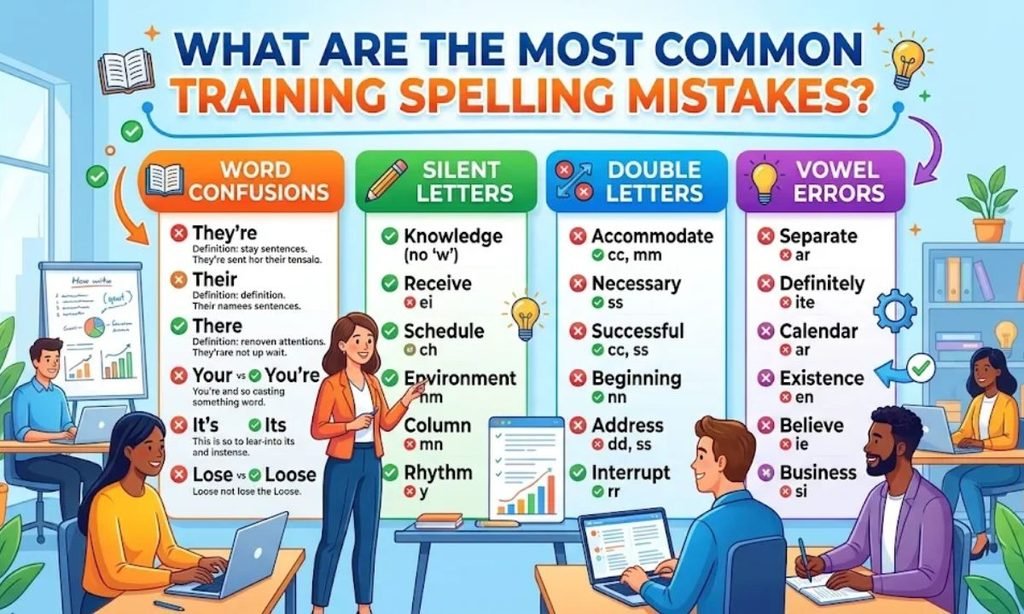
Everyone misspells a word now and then. These are the errors people make most often with this one.
Mistake 1: Doubling the n
Incorrect: He is attending trainning this week.
Correct: He is attending training this week.
The doubling rule does not apply because train has two vowel letters before the final consonant.
Mistake 2: Dropping the i
Incorrect: The new hire needs more traning.
Correct: The new hire needs more training.
The word needs both a and i in the first syllable, matching the base word train.
Mistake 3: Mixing up the ending
Incorrect: She is trainning for the half marathon.
Correct: She is training for the half marathon.
The same rule applies when the word is a verb. Add -ing to train with no change.
Mistake 4: Using a plural by default
Incorrect: I need to get some trainings before the audit.
Correct: I need to get some training before the audit.
Because training is usually uncountable, “some training” is the natural choice. More on that below.
Is Trainings a Real Word?
Yes, “trainings” is a real word, but it is used in a narrower way than “training.” It refers to separate sessions, courses, or programs, usually in a workplace or professional context.
- Acceptable: The HR team scheduled three trainings for next quarter.
- More traditional: The HR team scheduled three training sessions for next quarter.
Some editors prefer “training sessions” or “training programs” in formal writing because it sounds more standard. In everyday workplace English in the US, though, “trainings” is common and understood. If you are unsure, use “training sessions.”
What Related Words and Phrases Use Train?
Learning the whole word family makes the spelling easier to remember, because every form keeps the same train core.
- Trainer: a person who trains others (a personal trainer, a corporate trainer)
- Trainee: a person who is being trained
- Retrain: to train again or in a new skill
- Cross-training: training in more than one activity or skill
- On-the-job training: learning while doing the actual work
- Training wheels: small extra wheels that help a child learn to ride a bike
- Training manual: a written guide used to teach a task
- Well trained: having received good instruction (an adjective phrase)
Notice that none of these has a doubled n, which is a helpful clue that “trainning” does not belong with them.
How Can You Remember the Correct Spelling?
A few simple tricks can keep the spelling straight.
- Start with the base word. If you can spell train, add -ing and stop.
- Compare it to similar words. Rain becomes raining, gain becomes gaining, and train becomes training.
- Check the vowels. Two vowel letters before the last consonant usually means no doubling.
- Say it slowly. TRAY-ning has two clear syllables and only one n sound in the middle.
If you use a spell checker, it will flag “trainning” right away. It is still worth learning the reason, so you can spot the same pattern in other words.
FAQ’s
Is trainning ever correct?
No. “Trainning” is not correct in standard English. The correct spelling is “training.” The only time you would see “trainning” is as a typo.
What does training mean?
Training means the process of teaching or learning skills for a job, activity, or goal. It also covers physical preparation, such as marathon training or strength training.
How do I use training in a sentence?
Use it as a noun for the process or as a verb form for an action in progress. For example: “The nurses finished their safety training on Tuesday,” or “I’m training for a 10K.”
Is it “a training” or “training”?
Most of the time you use “training” without an article, because it is usually uncountable. You can say “a training” in some workplace settings to mean one session, but “a training session” is safer.
Is the spelling different in British English?
No. Both American and British English spell the word training.
Conclusion
Training has one n in the middle, and trainning is always a misspelling. The reason is easy to remember: train has two vowel letters before the final n, so you add -ing without doubling anything.
When in doubt, start from train and add the ending. Do that every time, and you will never reach for the extra n again.

Alex Jhon is the admin of Swift Timely, passionate about English grammar, word comparisons, vocabulary, and helping readers improve their language skills with clear, simple explanations.
1 thought on “Training vs Trainning: Which Spelling Is Correct?”