


You type “sponser,” and your spell checker underlines it in red. The confusion makes sense, because the last syllable sounds like “er,” and English spells that sound “er” in thousands of words. Still, the correct spelling is sponsor. “Sponser” is a misspelling, and this guide explains why, plus a simple way to get it right every time.
Which Spelling Is Correct: Sponsor or Sponser?
Sponsor is the correct spelling. “Sponser” is a misspelling and is not accepted in standard American or British English.
Use “sponsor” every time, whether you mean a person, a company, or the action of supporting something. That includes emails, resumes, school papers, grant applications, and social media posts.
What Does Sponsor Mean?
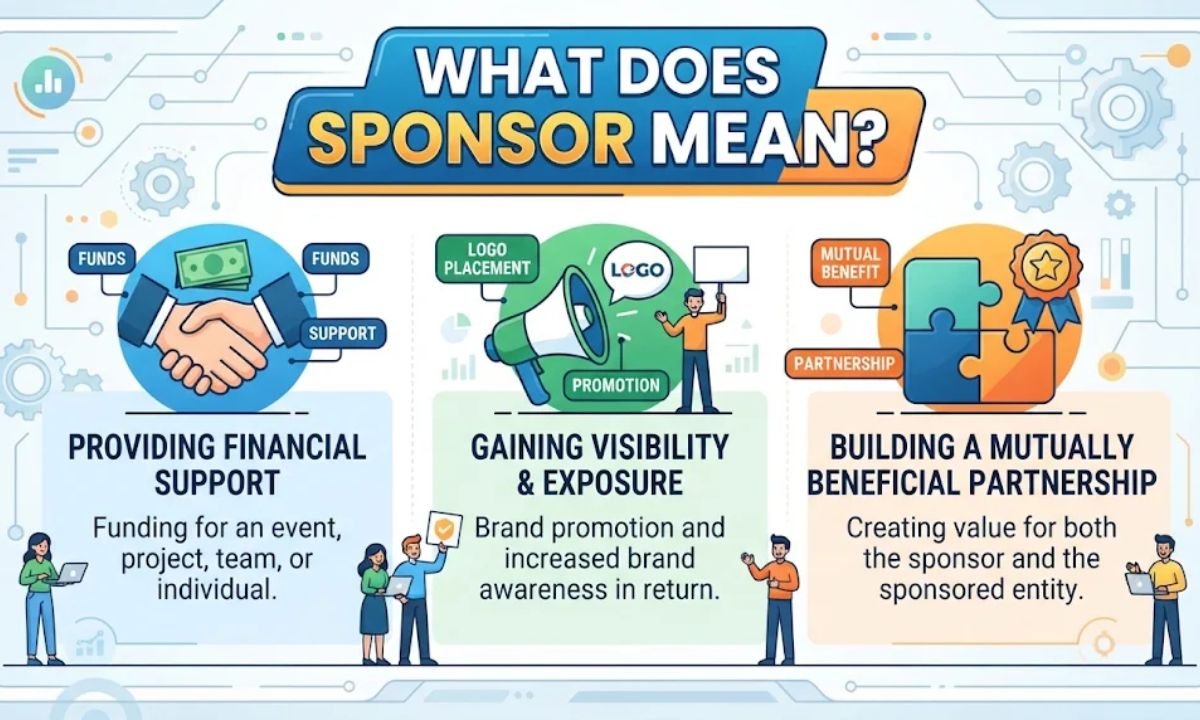
Sponsor has a few closely related meanings. As a noun, it can refer to:
- A person or organization that pays for or supports an event, team, show, or project, usually in exchange for publicity
- A person who vouches for or takes responsibility for another person, such as an immigration sponsor or a recovery program sponsor
- A person who presents a bill in a legislature
- A godparent or witness at a baptism or confirmation in some Christian traditions
As a verb, to sponsor means to provide financial or other support for something, or to take responsibility for someone.
Is Sponser Ever a Real Word?
No. “Sponser” is not an alternate spelling, a regional variant, or an older form of sponsor. Standard dictionaries do not list it as an accepted option.
You may occasionally see it as a surname, a brand name, or a username. Those are proper names, and the rule for proper names is simple: spell them the way their owners do. For the ordinary English word, always write sponsor.
Sponsor vs. Sponser at a Glance
| Term | Correct? | Meaning | Use |
| Sponsor | Yes | A supporter or backer; to support or back something | Use in all standard writing |
| Sponser | No | None (it is a misspelling) | Replace with “sponsor” |
Why Do People Spell Sponsor as Sponser?
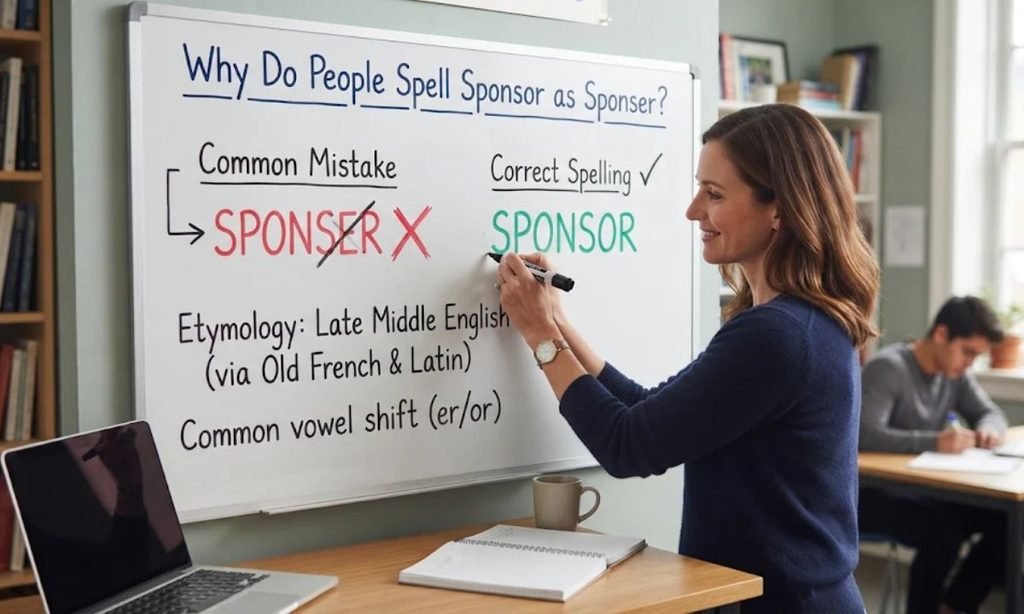
The mistake comes from sound. Native speakers say the ending as a quick, unstressed “er,” so the ear suggests the spelling “-er.” English has many words that really do end that way, such as teacher, builder, and farmer, so the guess feels reasonable.
Here is the pattern that helps. The ending -er is common in words with English or Germanic roots, like “teacher.” The ending -or shows up often in words that came through Latin, like actor, editor, doctor, and governor. This is a tendency, not a perfect rule, since some words break it. Sponsor comes from Latin, so it follows the -or pattern.
Read Related Post: Training vs Trainning: Which Spelling Is Correct?
How Do You Pronounce Sponsor?
In American English, sponsor is pronounced roughly “SPAHN-ser.” The stress falls on the first syllable, and the second syllable is short and soft.
British speakers say it close to “SPON-suh,” because the final r sound is usually dropped. In both versions, the ending sounds the same whether you spell it with an “o” or an “e,” which is exactly why the spelling trips people up.
Where Does the Word Sponsor Come From?
Sponsor comes directly from Latin, where it meant a guarantor, someone who made a solemn promise on behalf of another person. The Latin word grew out of the verb spondere, meaning “to pledge” or “to promise solemnly.”
That origin still shows in modern meanings. A sponsor pledges something: money, support, or personal responsibility. It also connects the word to relatives you already know. Spouse (one who has pledged), respond (to pledge back, or answer), and responsible (able to answer for something) all trace to the same Latin root.
How Does Sponsor Work as a Noun and a Verb?
Sponsor works as both a noun and a verb, and the spelling stays the same in both roles.
Noun forms:
- Singular: sponsor
- Plural: sponsors
Verb forms:
- Base form: sponsor
- Third person singular: sponsors
- Past tense and past participle: sponsored
- Present participle: sponsoring
Related forms:
- Sponsorship (noun): the support or backing itself
- Sponsored (adjective): paid for or backed by a sponsor, as in “sponsored content”
- Cosponsor (noun and verb): someone who shares sponsorship, common in politics
American and British English spell all of these the same way. There is no regional difference to memorize.
How Do You Use Sponsor in a Sentence?
Here are realistic examples from different settings.
Everyday conversation:
- “Our local hardware store is the main sponsor of the Little League team.”
- “My cousin agreed to sponsor her friend’s visa application.”
Workplace and business writing:
- “We are seeking a corporate sponsor for the spring conference.”
- “The marketing team will sponsor the booth at the trade show.”
Email:
- “Thank you for sponsoring our fundraiser. Your support made a real difference.”
Academic and formal writing:
- “Senator Alvarez is the lead sponsor of the education bill.”
- “The study was sponsored by a national research foundation.”
In that last example, “sponsored” is a past participle used in a passive sentence. It means someone provided funding for the study. The spelling stays “sponsor” plus “-ed.”
What Are the Most Common Sponsor Spelling Mistakes?
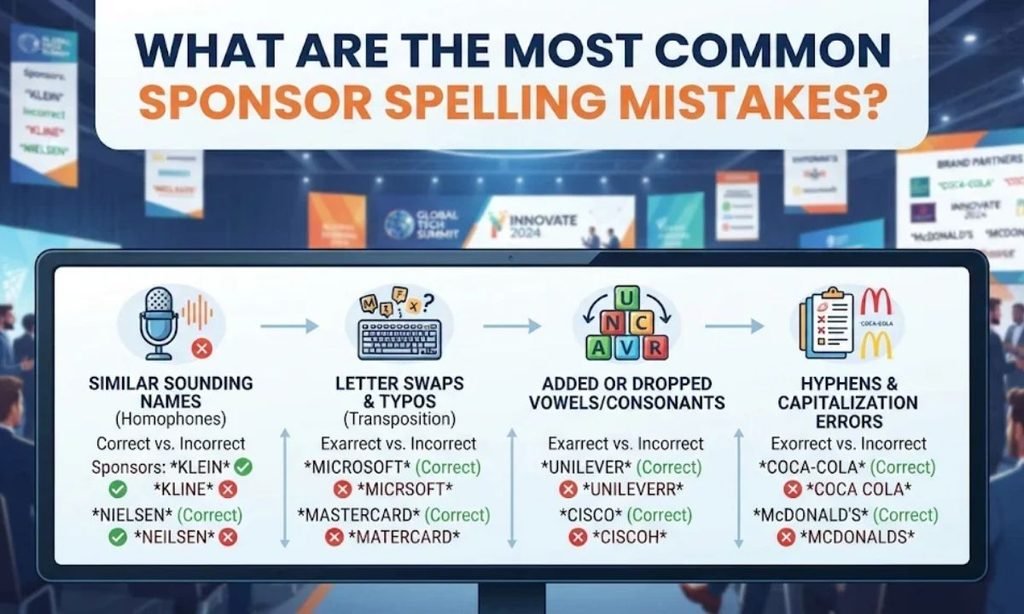
These mistakes are normal, and almost everyone makes a spelling error like this at some point.
Incorrect: Our company is the official sponser of the event.
Correct: Our company is the official sponsor of the event.
The noun ends in “-or,” not “-er.”
Incorrect: Thanks to everyone who sponsered the walk.
Correct: Thanks to everyone who sponsored the walk.
The past tense keeps the same base spelling, then adds “-ed.”
Incorrect: She received a sponsership for graduate school.
Correct: She received a sponsorship for graduate school.
The noun form is “sponsor” plus “-ship,” so the “o” stays.
Incorrect: We are looking for sponsers.
Correct: We are looking for sponsors.
The plural simply adds “s.”
Which Words Are Related to Sponsor?
Knowing the family helps you recognize the correct spelling. These words appear in the same contexts or share the same root:
- Synonyms: backer, patron, supporter, benefactor, underwriter, promoter
- Verb alternatives: fund, finance, back, underwrite, support
- Common phrases: title sponsor, corporate sponsor, lead sponsor, sponsored post, sponsor a child, sponsor a bill, sponsorship deal
- Word family: sponsorship, sponsored, cosponsor, sponsoring
- Same Latin root: spouse, respond, response, responsible
Notice that none of these words end in “-ser” in the base spelling. That is a helpful visual clue.
How Can You Remember the Correct Spelling?
Try one of these quick tricks.
Link it to similar words. Sponsor ends like actor, mentor, and investor. These are all people who do something, and all use “-or.”
Think of the word “or.” A sponsor gives you a choice: your project happens, or it does not. The “or” is the lifeline.
Say it with the “o” sound. When you write it, pronounce the ending as “sor,” not “ser,” just in your head. That small change can anchor the spelling.
Check the root words. If you can spell spouse and respond, you already know that the “spons-” part has an “o.” Then add “-or” to finish.
FAQ’s
Is “sponser” correct?
No. “Sponser” is a misspelling. The correct word is sponsor.
What does sponsor mean?
A sponsor is a person or organization that supports something, usually by providing money, resources, or personal backing. As a verb, to sponsor means to provide that support.
How do I use sponsor in a sentence?
You can use it as a noun or a verb. For example: “A local bakery is the sponsor of the school fair,” or “Our company will sponsor the community cleanup.”
Is there a British spelling of sponsor?
No. British and American English both spell it sponsor. Only the pronunciation differs slightly.
What is the past tense of sponsor?
The past tense is sponsored. For example: “The bank sponsored last year’s marathon.”
Conclusion
The right spelling is sponsor, and “sponser” is always a misspelling. Whether you mean a company that funds an event, a person who vouches for someone, or the act of backing a project, the word is spelled the same way.
If you remember one thing, remember this: sponsor ends in -or, just like actor and mentor.

Alex Jhon is the admin of Swift Timely, passionate about English grammar, word comparisons, vocabulary, and helping readers improve their language skills with clear, simple explanations.
1 thought on “Sponsor vs. Sponser: Which Spelling Is Correct?”