

You are typing a sentence about a teacher, and you pause: taught or tought? The confusion makes sense, because English spells similar sounds in wildly different ways (think of thought, bought, and caught). The answer is simple. Taught is correct, and tought is not a standard English word. In the taught vs tought question, taught is the only spelling to use.
Which Is Correct: Taught or Tought?
Taught is the correct spelling. It is the past tense and past participle of the verb “teach.” Tought is a misspelling and has no place in standard English.
You can use taught any time you are talking about teaching that already happened:
- She taught middle school math for ten years.
- I was taught to write thank-you notes.
If you ever feel tempted to write tought, swap it for taught. You will be right every time.
What Does Taught Mean?
Taught means that someone gave instruction, shared knowledge, or showed another person how to do something. It describes a completed action in the past.
The meaning covers more than classroom lessons. You can be taught by a parent, a coach, a manager, or even a mistake. Here are the main senses:
- Giving formal instruction: “Ms. Rivera taught biology at our school.”
- Showing a skill: “My grandfather taught me how to fish.”
- Leading to a lesson: “That failed project taught us to double-check our numbers.”
In every case, taught points backward in time to teaching that has finished.
Is Tought a Real Word?
No. Tought does not appear as a standard word in major American English dictionaries. It is a spelling error, not a regional variant or an older form of taught.
There is no hidden legitimate use. You will not find a context in standard writing where tought is the right choice, whether formal, casual, academic, or business.
People usually write it by mistake for a few reasons:
- Sound: Taught sounds like it could be spelled with an “o,” especially in accents where the vowel is pronounced “ot.”
- Pattern matching: Words like thought, bought, and fought end in “ought,” so the brain assumes teach follows the same pattern.
- Similar word: Tough looks a lot like tought, which adds to the visual mix-up.
Making this error does not mean you are bad at English. It means you noticed a pattern, and English happens to break it here.
Taught vs Tought at a Glance
| Term | Correct? | Meaning | Use |
| Taught | Yes | Past tense and past participle of “teach” | Use for any past teaching action |
| Tought | No | No meaning in standard English | Do not use; replace with “taught” |
If you only remember one row of this table, remember the first one.
Why Is Taught the Past Tense of Teach?
Teach is an irregular verb. Most English verbs form the past tense by adding “-ed” (walk becomes walked). Irregular verbs change in other ways, and teach changes its whole ending.
Here are all the forms:
| Form | Word | Example |
| Base form | teach | I teach on Tuesdays. |
| Third person singular | teaches | She teaches yoga. |
| Present participle | teaching | He is teaching a class. |
| Simple past | taught | They taught us last year. |
| Past participle | taught | We have taught this course before. |
Notice that the simple past and the past participle are the same word. That makes things easier: you never need a separate spelling for “have taught” or “was taught.”
Several other verbs follow a similar pattern, changing “-each” to “-aught” or “-ought”:
- teach, taught
- catch, caught
- buy, bought
- think, thought
- fight, fought
This explains why tought feels natural to some writers. It matches the shape of thought and bought. The difference is that teach takes “-aught,” like catch and caught.
A quick grammar note: some children and dialect speakers say teached. That is nonstandard. In standard US English, the past tense is always taught.
Read Related Post: Sponsor vs. Sponser: Which Spelling Is Correct?
How Do You Pronounce Taught?
Taught is pronounced like “tawt.” It rhymes with caught, naught, and fraught. In many parts of the United States, it sounds just like tot, because some accents blend the “aw” and “ah” vowels.
The “gh” in the spelling is silent. That silent “gh” is a leftover from older forms of English, and it is a big reason the word is hard to spell.
Here is a simple sound guide:
- t: a normal “t” sound
- aught: pronounced “awt”
- Together: “tawt”
Because the sound alone does not reveal the spelling, you have to memorize the written form. Pronunciation will not help you decide between taught and tought, since both would sound the same.
Where Does Taught Come From?
Taught comes from the Old English verb tǣcan, which meant to show or to point out. Its past tense in Old English was tǣhte. Over centuries, the spelling shifted through Middle English forms like taughte until it settled into modern taught.
The “gh” in taught reflects an old guttural sound that English speakers once pronounced in words like these. That sound faded from the language, but the spelling stayed. This pattern is why English has so many silent “gh” words, including caught, daughter, and thought.
Tǣcan is also related to the word token, since both come from an ancient root connected with showing or pointing. That link makes sense: teaching, at its core, is about showing someone something.
How Do You Use Taught in a Sentence?
Use taught whenever the teaching action is finished. Here are natural examples from different settings.
Everyday conversation
- “My dad taught me how to ride a bike in the driveway.”
- “Who taught you to cook like that?”
Workplace communication
- “Our senior developer taught the new hires how to use the ticketing system.”
- “I was taught to confirm every deadline in writing.”
Emails
- “Thank you for the training session. I learned a lot from what you taught us about client reporting.”
Academic writing
- “The course was taught by Dr. Alvarez for three consecutive semesters.”
- “Previous studies have taught researchers to account for sampling bias.”
Why it works: In “The course was taught by Dr. Alvarez,” taught is a past participle used in a passive sentence. The verb stays the same whether you say “Dr. Alvarez taught the course” or “The course was taught by Dr. Alvarez.”
Casual writing
- “Life taught me not to trust a weather app in April.”
Formal writing
- “The principles she taught continue to shape the curriculum.”
You can also use taught with a person, a subject, or both:
- She taught me (person).
- She taught algebra (subject).
- She taught me algebra (both).
What Are the Most Common Taught Mistakes?
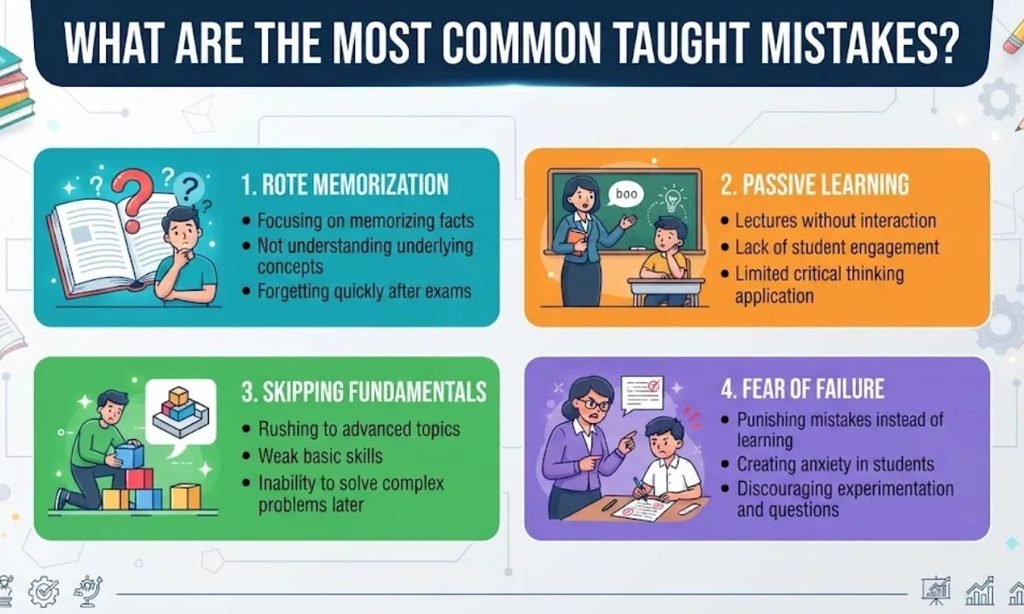
Most mistakes fall into a few predictable patterns. None of them is a sign of weak English. They are part of how everyone learns.
Mistake 1: Spelling it as “tought”
- Incorrect: She tought English for five years.
- Correct: She taught English for five years.
The “ought” ending belongs to thought and bought, not to teach.
Mistake 2: Using “teached”
- Incorrect: He teached us how to code.
- Correct: He taught us how to code.
Teach is irregular, so adding “-ed” does not work.
Mistake 3: Mixing up “taught” and “learned”
- Incorrect: I taught a lot from that class.
- Correct: I learned a lot from that class.
Taught is for the person giving instruction. Learned is for the person receiving it.
Mistake 4: Using the wrong tense
- Incorrect: Yesterday, she teach the lesson.
- Correct: Yesterday, she taught the lesson.
Any past-time clue, such as “yesterday” or “last year,” calls for taught.
Mistake 5: Confusing “taught” and “taut”
- Incorrect: The rope was pulled taught.
- Correct: The rope was pulled taut.
Taut means tight. More on this below.
Taught vs Taut vs Thought: What’s the Difference?
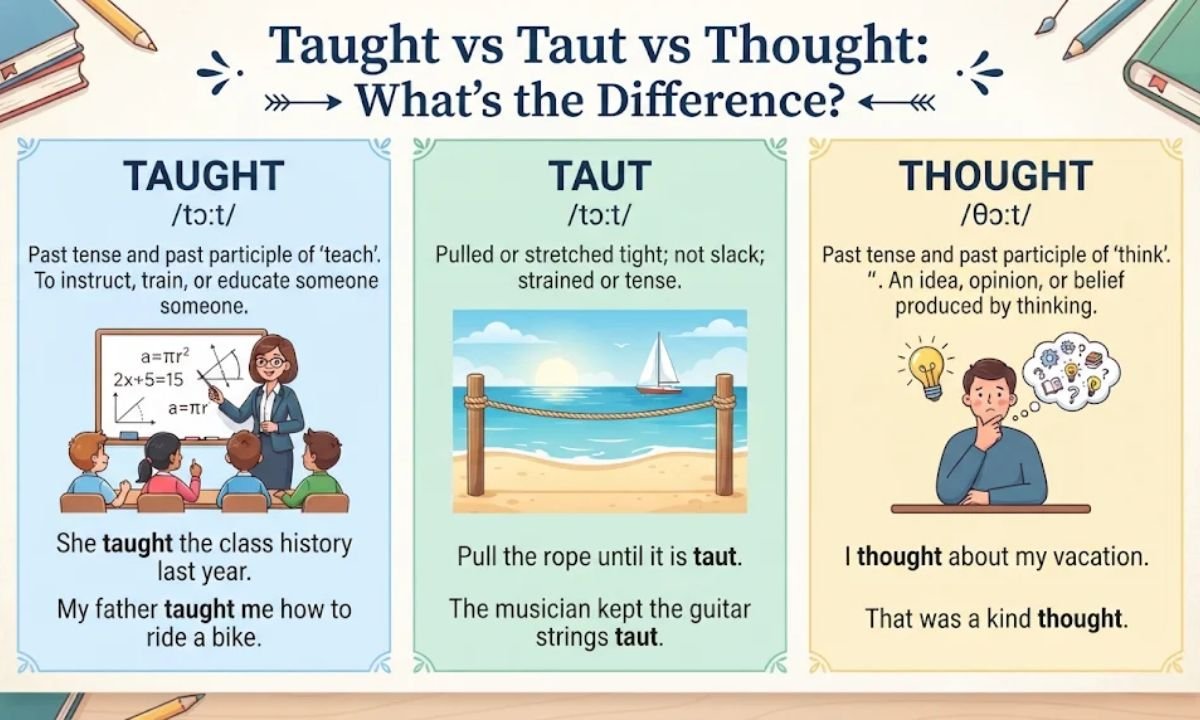
Three words in this family cause trouble because they look or sound alike. Keeping them separate removes most of the confusion.
| Word | Part of speech | Meaning | Example |
| Taught | Verb (past tense) | Gave instruction | She taught us to swim. |
| Taut | Adjective | Pulled tight | Keep the cable taut. |
| Thought | Verb (past tense) or noun | Considered, or an idea | I thought about it. / That’s a kind thought. |
Taught and taut often sound identical in everyday American speech, which is why people mix them up. The spelling is the only reliable clue. If you mean tight, write taut. If you mean instructed, write taught.
Thought is a different word entirely. It comes from the verb think, not from teach. If the sentence involves an idea or an opinion, you want thought.
How Can You Remember the Spelling?
Memory tricks help most when spelling does not follow the sound. Try these:
- The “au” trick: Taught and caught both have “au.” If you can say “I caught it,” you can say “I taught it.”
- The “a” in teach: Teach has an “a,” and so does taught. The “a” carries through from present to past.
- The “tough” reminder: Tought looks too much like tough. Since tough is a different word, treat any “tou” spelling as a warning sign.
- Say it with a friend: Pair the word with a phrase, such as “She taught, I caught.” The rhyme anchors the “aught” ending.
Pick one trick and use it until the spelling feels automatic.
FAQ’s
Is “tought” ever correct?
No. Tought is not a standard English word. Use taught every time.
What is the past tense of teach?
The past tense of teach is taught. The past participle is also taught, as in “She has taught here for years.”
How do I use “taught” in a sentence?
Use it for past teaching, such as “My neighbor taught me how to prune roses.” It works in active and passive sentences.
Is “taught” the same as “taut”?
No. Taught is a verb meaning instructed. Taut is an adjective meaning tight. They sound alike in many accents but have different spellings and meanings.
Why is the “gh” in “taught” silent?
The “gh” once represented a sound that English speakers stopped pronouncing. The spelling kept the letters even after the sound disappeared.
Conclusion
The right spelling is taught, and tought is simply an error. Taught is the past tense and past participle of teach, and it follows the same “aught” pattern as caught.
When in doubt, remember this: teach becomes taught, and tought is never the answer.
If you’d like, I can put this article in a Word doc or a shareable page for you.

Alex Jhon is the admin of Swift Timely, passionate about English grammar, word comparisons, vocabulary, and helping readers improve their language skills with clear, simple explanations.
1 thought on “Taught vs Tought: Which Spelling Is Correct?”