


You have probably typed a word, stared at it, and thought, “That doesn’t look right.” Placque is one of those words. The extra “c” sneaks in because the word sounds like “black” and “pack.” The correct spelling is plaque, and “placque” is a misspelling in standard American English.
Quick Answer: Is It Placque or Plaque?
Plaque is the correct spelling. Placque is a misspelling and has no place in standard American English.
Use plaque for a flat commemorative sign, for the sticky film on teeth, and for fatty deposits in arteries. If you see “placque” in your own draft, replace it with “plaque” every time. No sense or context makes “placque” acceptable.
What Does Plaque Mean?
Plaque is a noun with several related meanings. All of them center on the idea of a flat patch, layer, or plate.
- A flat sign or plate: a plaque is usually metal, stone, or wood, mounted on a wall or presented as an award. It often carries an inscription.
- Dental plaque: a soft, sticky film of bacteria that forms on teeth.
- Arterial plaque: a buildup of fat, cholesterol, and other substances inside blood vessels.
- Other medical uses: doctors also use the word for raised, flat patches on skin, and for protein deposits in the brain.
When you read a sentence, the context tells you which meaning applies. The spelling never changes.
Why Do People Misspell Plaque as Placque?
Three things cause the confusion.
First, the pronunciation misleads. The word sounds like plack, so the ending seems to need a “ck” or “cq” to make the “k” sound. English spells that sound many ways: “back,” “ache,” “chorus,” “unique.”
Second, the “-que” ending is unusual. Many learners see it mostly in French-influenced words, so their brains reach for a more familiar pattern.
Third, English has real words with “cq,” such as “acquire” and “lacquer.” That makes “placque” look plausible even though it isn’t a word.
Is Placque Ever Correct?
No. Placque is not a variant spelling, an older spelling, or a British alternative. Major American dictionaries list only plaque.
Two edge cases can make “placque” appear in print:
- Names: a person or business might use an unusual spelling as a proper name. That is a naming choice, not a standard spelling of the word.
- Typos: swapping or doubling letters is easy when typing fast. Spell checkers usually catch this one.
For everything else, plaque is the only correct choice.
Placque vs Plaque: Comparison Table
| Term | Correct? | Meaning | Use |
| Plaque | Yes | A flat commemorative sign, a bacterial film on teeth, or a deposit in arteries | All writing, formal and informal |
| Placque | No | None. It is a misspelling | Replace with “plaque” |
The table gives you the whole rule. There is one real word, and the other is a common slip.
How Do You Pronounce Plaque?
Plaque rhymes with “black,” “stack,” and “crack.” In American English, the vowel is the short “a” sound.
The phonetic spelling is /plæk/. It has one syllable.
The “-que” at the end is silent in terms of vowel sounds. It only produces the final “k” sound, much like the ending of “antique,” “unique,” or “boutique.”
Some people say “plahk” or “plawk” because they have seen the word in a French context. In standard American English, “plack” is correct.
What Part of Speech Is Plaque?
Plaque is a noun. It names a thing: a sign, a film, a deposit.
Singular and plural: the singular is plaque, and the plural is plaques. Just add “s.”
- The company mounted a plaque by the entrance.
- The hallway was lined with plaques honoring former employees.
Countable and uncountable use: when you mean the plaque on a sign or an award, it is countable (“two plaques”). When you mean the substance in your mouth or arteries, it is usually uncountable: “Brushing removes plaque.” You would not normally say “a plaque” for that dental meaning.
Plaque as a noun adjunct: the word often works like an adjective in front of another noun, as in “plaque buildup” or “plaque removal.” It is still a noun in these phrases.
Verbs and adverbs: plaque has no standard verb or adverb form. You do not “plaque” something. Say “mounted a plaque” or “built up plaque,” never “plaqued.”
American vs British English: both varieties use the same spelling, plaque, so there is no regional difference to worry about.
Read Related Post: Taught vs Tought: Which Spelling Is Correct?
Where Does the Word Plaque Come From?
English borrowed plaque from French. The French word traces back to a Middle Dutch word meaning a flat disk or plate, which is why the core idea of the word is “something flat and thin.”
That origin explains how the meanings connect. A commemorative sign is a flat plate. The layer on teeth is a thin film. A fatty deposit on an artery wall is a flat patch. The medical uses came later, built on the same picture.
The “-que” ending is a leftover from French spelling. English kept it, which is why the word looks unusual next to native English words.
How Do You Use Plaque in a Sentence?
Here are natural examples across different settings.
Everyday conversation:
- My dentist said I need to floss more to get rid of plaque.
- Did you see the plaque outside the old library?
Workplace communication:
- We’re ordering a plaque for Dana’s ten years of service.
- Please confirm the wording for the plaque by Friday.
Academic writing:
- Researchers studied how plaque forms in the arteries of older adults.
- The museum placed a bronze plaque beside the monument to explain its history.
Email:
- Hi Marcus, the plaque arrived today, and the engraving looks great.
Formal writing:
- A commemorative plaque was unveiled at the dedication ceremony.
In the academic example, “plaque forms” works because plaque is the substance, so it takes no article. In the museum example, “a bronze plaque” uses an article because it is a single physical object.
What Are Common Plaque Spelling Mistakes?
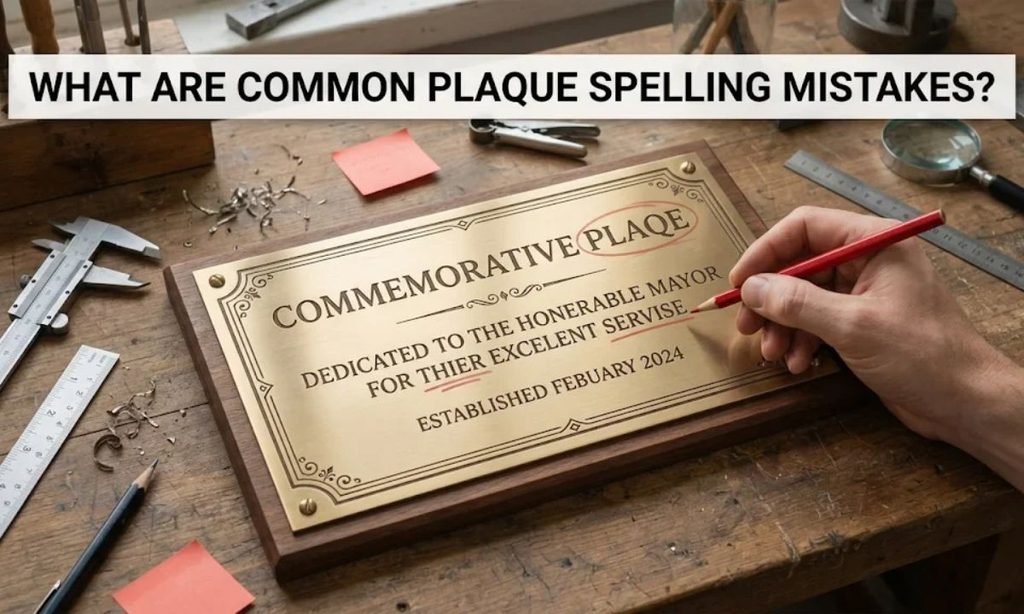
These errors are normal, and most writers make at least one of them at some point.
Mistake 1: adding an extra “c”
Incorrect: The dentist pointed out placque near my gumline.
Correct: The dentist pointed out plaque near my gumline.
The “k” sound is made by “que,” so no extra “c” is needed.
Mistake 2: using “ck”
Incorrect: They hung a plack in the lobby.
Correct: They hung a plaque in the lobby.
“Plack” looks logical because it matches “black,” but English spells this word with “que.”
Mistake 3: using “plaquet” or “plaqe”
Incorrect: He received an award plaqe.
Correct: He received an award plaque.
Keep the full “-que” ending. The “u” and “e” are both required.
Mistake 4: forming the plural wrongly
Incorrect: The wall displayed several plaque.
Correct: The wall displayed several plaques.
When you mean more than one sign, add “s.”
Related Words and Easy Ways to Remember Plaque
Several words connect to plaque in meaning or spelling. Knowing them helps the word stick.
Related meaning:
- Tartar: hardened plaque on teeth, also called calculus
- Biofilm: the scientific term for the bacterial layer behind dental plaque
- Cavity: tooth decay that plaque can contribute to
- Plate, tablet, placard: nearby words for flat signs, though each has its own use
- Cholesterol: a substance involved in arterial plaque
- Gingivitis: gum inflammation linked to plaque buildup
Common phrases:
- dental plaque
- plaque buildup
- commemorative plaque
- memorial plaque
- brass plaque
- arterial plaque
Words that share the “-que” ending: unique, antique, technique, boutique, mosque. Think of plaque as part of that group.
A simple memory trick: picture a plaque on a wall, and remember it has a “que” like “technique.” If you can spell “unique,” you can spell plaque. Another way: plaque has no c before the q, and “cq” never starts the ending.
FAQ’s
Is placque correct?
No. Placque is a misspelling. The correct spelling is plaque.
What does plaque mean?
Plaque means a flat commemorative plate or sign, or a sticky film or deposit, such as the bacteria on teeth or fatty buildup in arteries.
How do I use plaque in a sentence?
Use it as a noun. For example: The school unveiled a plaque honoring its founder. For the dental meaning: Flossing helps remove plaque between your teeth.
What is the plural of plaque?
The plural is plaques. For example: The lobby has three plaques on the wall.
Is plaque spelled differently in British English?
No. American and British English both spell it plaque.
Conclusion
Plaque is the only correct spelling, whether you mean a sign on a wall, a film on your teeth, or a deposit in an artery. Placque is a common slip, not a real word. Remember that plaque ends in “que,” just like “unique,” and the extra “c” never belongs.
If you’d like, I can turn this into a Claude Doc you can edit, share, or download as Word or PDF.

Alex Jhon is the admin of Swift Timely, passionate about English grammar, word comparisons, vocabulary, and helping readers improve their language skills with clear, simple explanations.
1 thought on “Placque vs Plaque: Which Spelling Is Correct?”