

You are typing a quick text when the word suddenly looks wrong. Is it messege or message? The confusion is understandable. The ending sounds like “ij,” and English spells that sound with “ege” in words like college and privilege. The correct spelling is message, with an “a” before “ge.” “Messege” is a misspelling and has no accepted use in English.
What Is the Correct Spelling: “Messege” or “Message”?
The correct spelling is “message.” “Messege” is always incorrect. Every major American and British dictionary lists only “message,” so you can use it with confidence in any context, from a casual text to a legal contract.
The word has seven letters: m-e-s-s-a-g-e. A quick way to check yourself is to look at the sixth letter. It should be an “a,” not an “e.”
What Does “Message” Mean?
A message is a piece of information that one person or group sends to another. It can be spoken, written, or digital. It can also mean the main point or idea behind something, such as a speech, a film, or an advertisement.
Here are the most common meanings:
- A communication: “I left you a message at the front desk.”
- A central idea: “The message of the story is that patience pays off.”
- An official statement: “The president delivered a message to Congress.”
- A digital note: “She sent me a message on her phone.”
All four meanings use the same spelling. Context tells you which one is intended.
Is “Messege” Ever Correct?
No. “Messege” is not a variant spelling, a regional spelling, or an old form of the word. It is simply a typo or a spelling error.
Some word pairs do have two acceptable spellings, such as “gray” and “grey” or “judgment” and “judgement.” This is not one of them. A spell checker will flag “messege” every time, and so will most editors and teachers.
“Messege” vs. “Message”: Quick Comparison
| Spelling | Correct? | Meaning | Use |
| Message | Yes | Information sent to someone, or a central idea | Use in all writing, formal and informal |
| Messege | No | None (a misspelling) | Never use; replace with “message” |
If you remember one row of this table, make it the first one.
Why Do People Spell “Message” as “Messege”?
There are two good reasons this mistake happens.
First, English has a handful of common words that end in “ege.” College, knowledge, privilege, and sacrilege all use it. The brain sees a familiar pattern and applies it where it does not belong.
Second, the final syllable in “message” is unstressed. When a syllable is quiet, the vowel inside it blurs into a short “ih” sound. You cannot hear whether the vowel is an “a” or an “e,” so you have to remember it.
Most words that end with the same sound use “age” instead: package, passage, village, image, damage, language, and courage. Message belongs to that larger family.
A simple memory trick: think of the “age” inside the word. A message is a message at any age. If it helps, picture the word “sage” tucked inside “message” (mess-AGE). If you can find “age” at the end, you have spelled it correctly.
How Is “Message” Pronounced?
In American English, “message” is pronounced MESS ij. The stress falls on the first syllable. The second syllable is short and light, and it rhymes with the end of “village.”
You say it with two syllables, not three. The “a” is not pronounced like the “a” in “cake” or “mass.” It becomes a soft “ih” sound.
Pronunciation is nearly identical in British English. Both varieties also share the same spelling, so there is no American versus British difference to worry about here.
Is “Message” a Noun or a Verb?
“Message” works as both a noun and a verb. The noun use is older and more traditional. The verb use is common in modern writing, especially in business and technology.
As a noun, “message” names the thing that is sent:
- “I got your message.”
- “Please read the message below.”
As a verb, “message” means to send a message to someone:
- “I’ll message you after the meeting.”
- “She messaged the team on Slack.”
Here are all the forms:
| Form | Example |
| Singular noun | message |
| Plural noun | messages |
| Base verb | message |
| Third person singular | messages |
| Past tense | messaged |
| Present participle | messaging |
The plural is regular: just add “s.” The verb is also regular, so you drop the final “e” before adding “-ing” (messaging), but keep it before “-d” (messaged).
The verb use is fully accepted in everyday American English. In very formal writing, some editors prefer “send a message” instead of “message someone.” That is a style preference, not a grammar rule.
Read Related Post: Placque vs Plaque: Which Spelling Is Correct?
Where Does the Word “Message” Come From?
“Message” entered English from Old French in the Middle Ages. The French word traces back to Medieval Latin, and ultimately to the Latin verb mittere, which means “to send.”
This origin explains why the idea of sending sits at the heart of the word. A message is, at its root, something that is sent.
The same Latin source gave English several related words, including mission, missile, missive, and permit. Seeing the family helps you appreciate how closely connected the idea of “sending” is to all of them.
“Messenger” also comes from the same root. It has an extra “n,” which crept in over time and is not found in “message.”
How Do You Use “Message” in a Sentence?
Here are realistic examples from different settings. Each one uses the correct spelling.
Everyday conversation
- “Did you get my message?”
- “Leave a message after the beep.”
Text and social media
- “I’ll send you a message when I land.”
- “Message me if you need anything.”
Workplace and email
- “Thanks for your message. I will respond by Friday.”
- “Please see the message below for the updated schedule.”
Academic writing
- “The author’s central message is that education should be accessible to everyone.”
- “The poem’s message becomes clearer in the final stanza.”
Business and marketing
- “Our brand message should stay consistent across every channel.”
- “The campaign’s message resonated with younger customers.”
Formal writing
- “The committee issued a formal message of condolence.”
In the academic examples, “message” refers to the main idea, not a piece of correspondence. Both uses are standard.
What Are the Most Common Mistakes With “Message”?
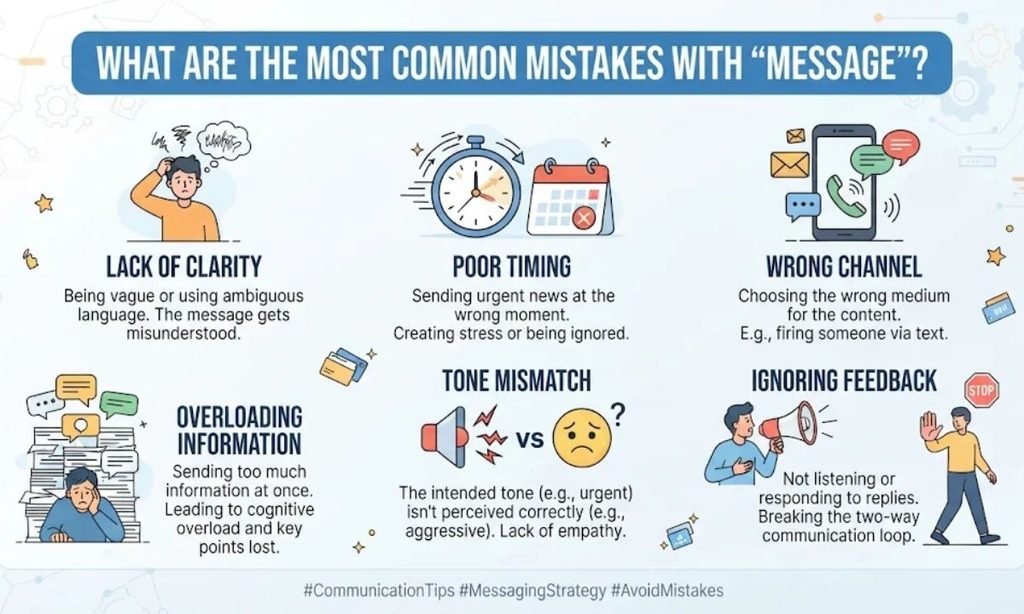
Everyone misspells words sometimes. Here are the mistakes people make most often with this one, along with the fixes.
Mistake 1: Using “messege”
- Incorrect: I will send you a messege tonight.
- Correct: I will send you a message tonight.
The vowel before the final “ge” is “a,” not “e.”
Mistake 2: Using “massage” by accident
- Incorrect: Please leave a massage with the receptionist.
- Correct: Please leave a message with the receptionist.
“Massage” is a real word, but it means rubbing muscles. It sounds similar, so spell checkers will not catch it. Check the first vowel: “message” starts with “mess.”
Mistake 3: Adding an extra “n” or dropping a letter
- Incorrect: She sent a mesage.
- Correct: She sent a message.
Remember the double “s.” Think of “mess” at the front of the word.
Mistake 4: Confusing “message” and “messenger”
- Incorrect: The messenger was short and clear. (when you mean the content)
- Correct: The message was short and clear.
The message is what is sent. The messenger is the person or tool that carries it.
What Words Are Related to “Message”?
Learning a few related terms makes the word easier to remember and use.
Synonyms: note, memo, text, communication, letter, dispatch, announcement, and word (as in “send word”).
Related nouns: messenger, messaging, inbox, voicemail, email, and notification.
Common phrases:
- “Get the message” means to understand what someone is hinting at.
- “Send a message” can mean to make a point through actions, not words.
- “On message” describes someone who stays focused on an official talking point.
- “Off message” means the opposite.
- “Take a message” means to write down information for someone who is unavailable.
Related forms: messaging (the act or system of sending messages), instant message, text message, and direct message (often shortened to DM).
You will also see “messaging” in the business world, where it means the way a company communicates its ideas, as in “our messaging needs to be clearer.”
FAQ’s
Is “messege” correct?
No. “Messege” is a misspelling. The correct spelling is message, with an “a” in the sixth position.
What does “message” mean?
A message is information sent from one person or group to another. It can also mean the main idea or lesson behind a piece of communication, such as a speech or a story.
How do I use “message” in a sentence?
Use it as a noun for the thing sent, or as a verb for the act of sending. For example: “I read your message this morning,” or “I’ll message you later today.”
Is “message” spelled differently in British English?
No. American and British English both spell it message. The pronunciation is also nearly identical.
How can I remember the spelling?
Look for the word “age” at the end of “message.” If you can see “age,” you have the right spelling. Another option is to link it to similar words like “package” and “passage.”
Conclusion
The spelling you want is always message. “Messege” is a common slip, but it is never correct, and it has no regional or historical standing.
When in doubt, remember that every message ends with “age.” Spell it that way, and you can send your next text, email, or note without a second thought.

Alex Jhon is the admin of Swift Timely, passionate about English grammar, word comparisons, vocabulary, and helping readers improve their language skills with clear, simple explanations.
1 thought on ““Messege” or “Message”: Which Spelling Is Correct?”