


Baler or bailer? The two words sound identical, so it is easy to grab the wrong spelling. Here is the quick answer: a baler is a machine that compresses hay, paper, or scrap into bundles, while a bailer is a bucket, tool, or person that removes water or fluid. Both are real words. This guide explains the baler vs bailer difference so you can pick the right one.
Which Is Correct, Baler or Bailer?
Both are correct, but they mean different things. Use a baler for a machine or person that makes bales. Use a bailer for a container, tool, or person that scoops out water or other liquid.
Neither spelling is a mistake in itself. The error happens when you use one in the other’s job. A farmer does not own a bailer for hay, and a boater does not carry a baler for a leaky hull.
If you are writing about compressing material into tight bundles, you want baler. If you are writing about getting liquid out of something, you want bailer.
What Does Baler Mean?
A baler is a machine that gathers loose material, presses it down, and ties it into a compact bundle called a bale. Balers are common in farming and recycling.
Here are the most familiar types:
- Hay baler: Packs cut hay or straw into square or round bales.
- Cardboard baler: Squeezes flattened boxes into dense blocks for recycling trucks.
- Scrap metal baler: Crushes metal waste into manageable cubes.
The word can also describe a person who bales, though that use is less common. A worker who runs the machine is usually called an operator, but “baler” for a person does appear in agricultural writing.
Example: The farm bought a new round baler before the second cutting of hay.
What Does Bailer Mean?
A bailer is something or someone that bails, meaning it scoops or removes liquid. The word has three everyday uses:
- A boat tool: A small bucket, jug, or scoop used to throw water out of a boat.
- A person: Someone who is bailing water out of a boat, basement, or similar space.
- A well tool: A long tube or container lowered into a well or borehole to collect or remove water, sediment, or other fluid. Groundwater technicians and drillers use this meaning.
Example: She cut the top off a plastic jug and used it as a bailer after the rain filled the canoe.
One caution: the person who posts money to free someone from jail is not normally called a bailer. People usually say bail bondsman, surety, or simply “the person who posted bail.” Legal writing about property uses bailor and bailee, which are different words.
Baler vs Bailer: Side-by-Side Comparison
| Term | Correct? | Meaning | Typical Use |
| Baler | Yes | A machine (or person) that presses material into bales | Farming, recycling, waste handling |
| Bailer | Yes | A tool or person that removes water or liquid | Boating, flooding, well work |
| Baler (for water) | No | Wrong word for a water scoop | Avoid |
| Bailer (for hay) | No | Wrong word for a hay press | Avoid |
The simple test: if the job involves squeezing and tying, choose baler. If the job involves scooping out liquid, choose bailer.
Why Do Baler and Bailer Sound the Same?
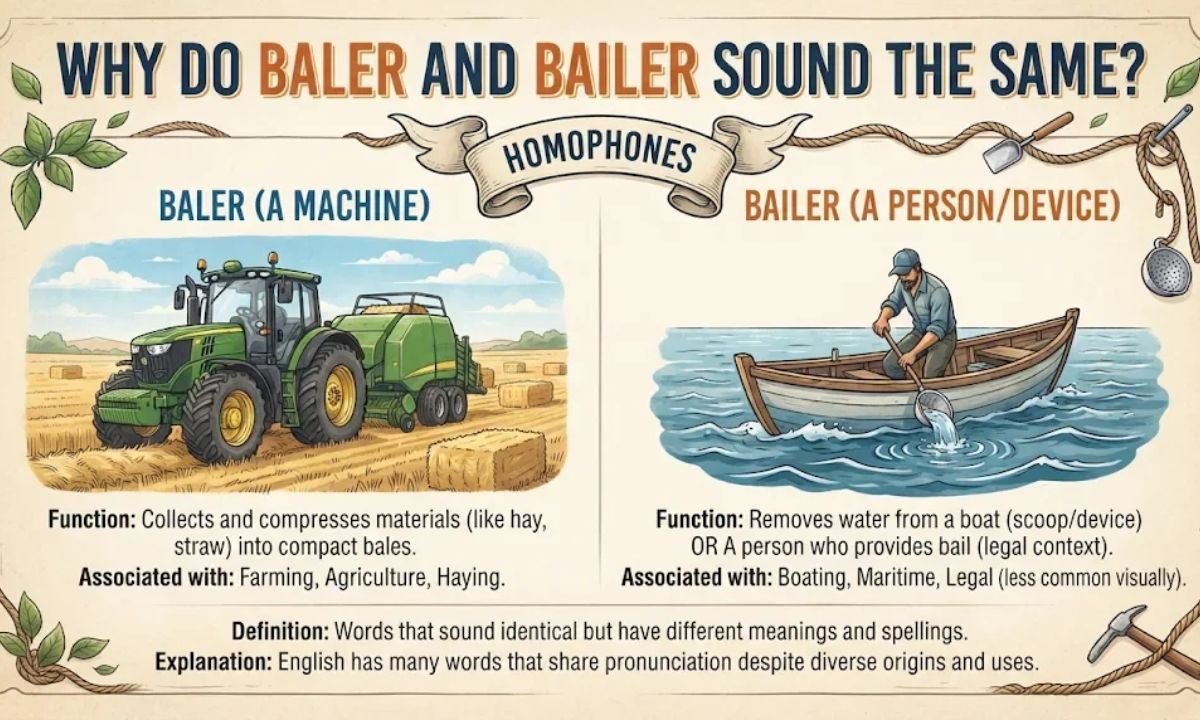
Baler and bailer are homophones, which means they are pronounced the same way: BAY-lur. Both are written in the International Phonetic Alphabet as /ˈbeɪlər/. Because your ear cannot tell them apart, you have to rely on spelling and context.
The confusion starts one step earlier, with the root words. Bale (a bundle) and bail (to scoop, or a type of bond) are also homophones. Add the “-er” ending to each and you get baler and bailer.
Here is the full homophone family:
- Bale: A large bundle, such as a bale of hay.
- Bail: To remove water from a boat, to secure release from jail with money, or the curved handle of a bucket.
- Bale (verb): To make material into bales.
- Bail (verb): To scoop water out, or to leave a situation (informal).
Once you know which root belongs to which meaning, the right spelling usually follows.
How Do Baler and Bailer Work Grammatically?
Both words are nouns. Each is formed by adding the agent suffix “-er” to a verb, which creates a word meaning “one that does this action.”
- Bale (verb) + er = baler (one that bales)
- Bail (verb) + er = bailer (one that bails)
They follow regular patterns in other forms too:
| Form | Baler | Bailer |
| Singular noun | baler | bailer |
| Plural noun | balers | bailers |
| Base verb | bale | bail |
| Third person | bales | bails |
| Past tense | baled | bailed |
| Present participle | baling | bailing |
The present participle of bale is baling, which you see in “baling wire” and “baling twine.” The participle of bail is bailing, as in “bailing out the boat.”
Both words work in formal and informal writing. They are plain, practical nouns, so you will see them in manuals, farm reports, boating guides, and ordinary conversation.
American and British spelling does not change either word. The meanings and spellings are the same on both sides of the Atlantic. One related difference is worth knowing: British English often writes “bale out” for leaving an aircraft by parachute, while American English usually writes “bail out.”
Read Related Post: “Messege” or “Message”: Which Spelling Is Correct?
Where Do the Words Come From?
The two roots have separate histories, which is why the meanings never overlapped.
Bale (a bundle) entered English in the Middle Ages and is connected to words for a round package or ball in older European languages. The idea of a tightly packed bundle has stayed with the word ever since.
Bail (to scoop water) comes into English from Old French baille, meaning a bucket or pail, which in turn goes back to a Latin word for carrying. That makes sense: a bailer carries water out.
The “bail” of “bail bond” has a separate line of descent, from a French word meaning to deliver or hand over. English later spelled the two looking-alike words the same way, but they began as different words.
The key takeaway is that the “ai” spelling in bailer comes from the bucket and water root, and the “a_e” spelling in baler comes from the bundle root.
How Do You Use Baler and Bailer in Sentences?
Here are natural examples from different settings.
Everyday conversation
- “Dad rented a baler so we could finish the field before the storm.”
- “Grab the bailer, the boat’s taking on water!”
Workplace communication
- “Please schedule maintenance for the cardboard baler in the loading dock.”
- “The field crew will need a bailer to clear water from the borehole before sampling.”
- “Hi Marcus, the baler jammed again this morning. Can you send someone from facilities?”
- “We are short one bailer for the kayak rentals. Could you order two more?”
Academic and technical writing
- “The study compared the density of bales produced by two types of balers.”
- “Researchers lowered a bailer into the monitoring well to collect a groundwater sample.”
Why these work: In each pair, the context tells you what the object does. Compressing, tying, or bundling points to baler. Scooping, clearing, or collecting liquid points to bailer.
What Mistakes Do People Make With Baler and Bailer?
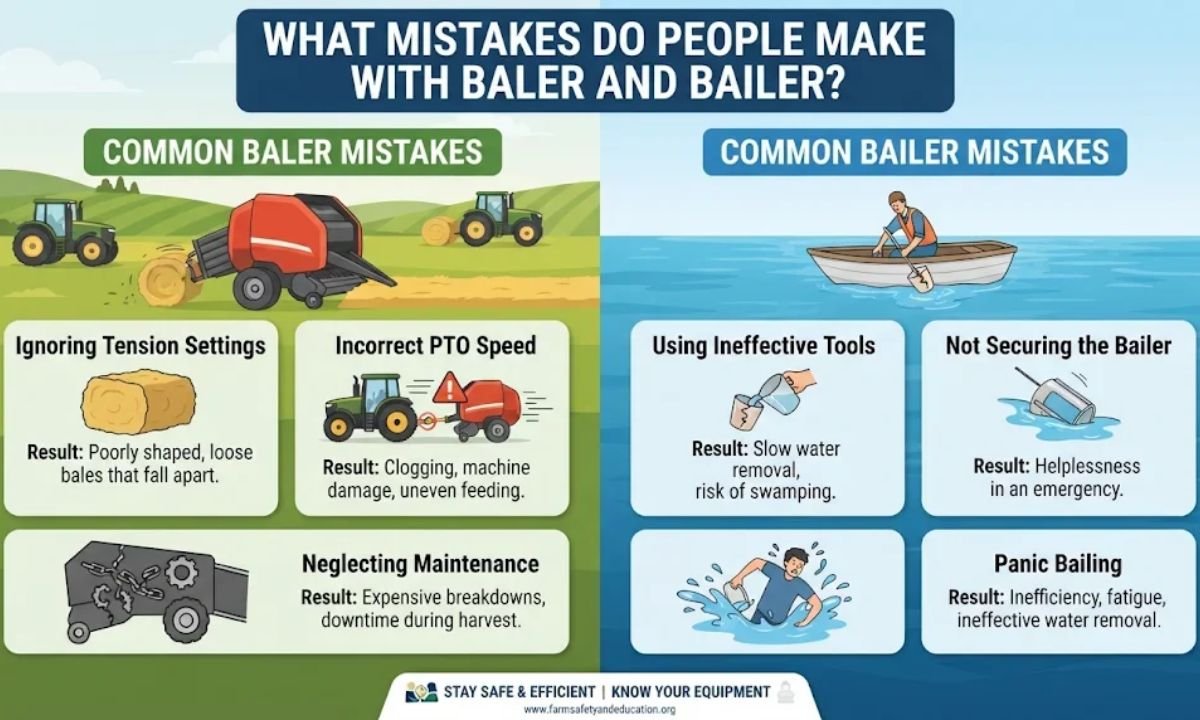
These mix-ups are normal, because the words sound the same. Here are the most common ones.
Mistake 1: Using bailer for hay equipment
Incorrect: We hired a bailer to pack the hay.
Correct: We hired a baler to pack the hay.
Hay is packed into bales, so the machine is a baler.
Mistake 2: Using baler for a water scoop
Incorrect: Hand me the baler, the canoe is filling up.
Correct: Hand me the bailer, the canoe is filling up.
Removing water is bailing, so the scoop is a bailer.
Mistake 3: Mixing up the verbs
Incorrect: The crew is bailing the cardboard.
Correct: The crew is baling the cardboard.
If the action is making bales, the verb is bale, and the participle drops the “i.”
Mistake 4: Using bailer for the person who posts bond
Incorrect: He was the bailer who got her out of jail.
Correct: He was the bail bondsman who got her out of jail. (Or: He posted her bail.)
Bailer is not the usual word for this role.
What Related Words Should You Know?
A few nearby terms will help you stay on track:
- Baling wire and baling twine: Materials used to tie bales.
- Round baler and square baler: Common agricultural machine types.
- Compactor: A related machine that compresses waste, though it does not always tie it into bales.
- Bilge pump: A powered way to remove water from a boat, as opposed to a hand bailer.
- Scoop and dipper: Informal words for a simple water bailer.
- Bail out: To remove water, to leave a situation, or to rescue someone from trouble.
- Bale out: A British variant for leaving an aircraft.
- Bailee and bailor: Legal terms for parties in a bailment, not the same as bailer.
How Can You Remember Which Spelling to Use?
Try these quick memory tricks:
- Baler has no “i” because the machine has no water. A baler works with dry material.
- Bailer has an “i” like the “i” in liquid. If liquid is involved, use the “ai” spelling.
- A bale and a baler both have “a_e.” The shared spelling links the bundle to the machine.
You can also ask one question: Is something being bundled or drained? Bundled means baler. Drained means bailer.
Frequently Asked Questions
Is it baler or bailer?
Both are correct, but they are not interchangeable. Baler is a machine that presses material into bales. Bailer is a tool or person that removes water or fluid.
What is a baler used for?
A baler compresses loose material such as hay, straw, cardboard, plastic, or scrap metal into compact bundles. This makes the material easier to store, move, and recycle.
What is a bailer used for?
A bailer removes liquid from a space. On a boat, it is a scoop or bucket used to throw water overboard. In well work, it is a tube lowered into a well to collect or remove fluid.
How do you use baler and bailer in a sentence?
“The farmer cleaned the baler after harvest.” “She used a bailer to empty the rowboat.” In each sentence, the object matches the task: bundling for baler, removing water for bailer.
Conclusion
Baler and bailer sound the same but do different jobs. A baler squeezes material into bales. A bailer scoops liquid out. Both spellings are legitimate, so the only question is what the object does.

Alex Jhon is the admin of Swift Timely, passionate about English grammar, word comparisons, vocabulary, and helping readers improve their language skills with clear, simple explanations.
1 thought on “Baler vs Bailer: What’s the Difference and Which One Do You Need?”